
Introduction
Have you ever asked yourself Why do all the same doctors and hospitals treat folks who are healthier than others? Since the answer often exists beyond the walls of a clinic. It exists in neighborhoods, schools, workplaces and communities. This is precisely the purpose of SDOH.
So, what is SDOH? Full form for SDOH: Social Determinants of Health. These are the non-medical factors that affect your health outcomes. They determine your longevity, sickness frequency and recovery ability. Defining SDOH in healthcare is the first significant step towards a healthier and equitable society.
What is social determinants of health (SDOH) — Break it down — what it means, key social determinants of health, important topic and how to improve them?
What Does SDOH Stand For?
Researchers and medical professionals refer to factors that impact health outcomes as SDOH (Social Determinants of Health). The term refers to wide variety of social, economic and environmental condition affecting health. These do not begin to cover the clinical or biological arena. Rather, they are the normal conditions in which people are born, grow, live, work and age.
The breadth of this explanation often surprises those who are interested in what SDOH stands for. Everything from your income and education level to the safety of your neighborhood and access to fresh water. These all have an impact on your physical and mental health in significant ways.
Abstract: SDOH meaning is more than doctors and medications. It tells the complete story of other aspects that affect your health from day to day.
The Social Determinants of Health Explained
There are questions people often ask: what do we mean by social determinants of health, and how are they different from anything related to medicine? The World Health Organization (WHO) and the Centers for Disease Control and Prevention (CDC) defined social determinants as conditions in which people are born, grow, live, work and age that shape health risks or outcomes.
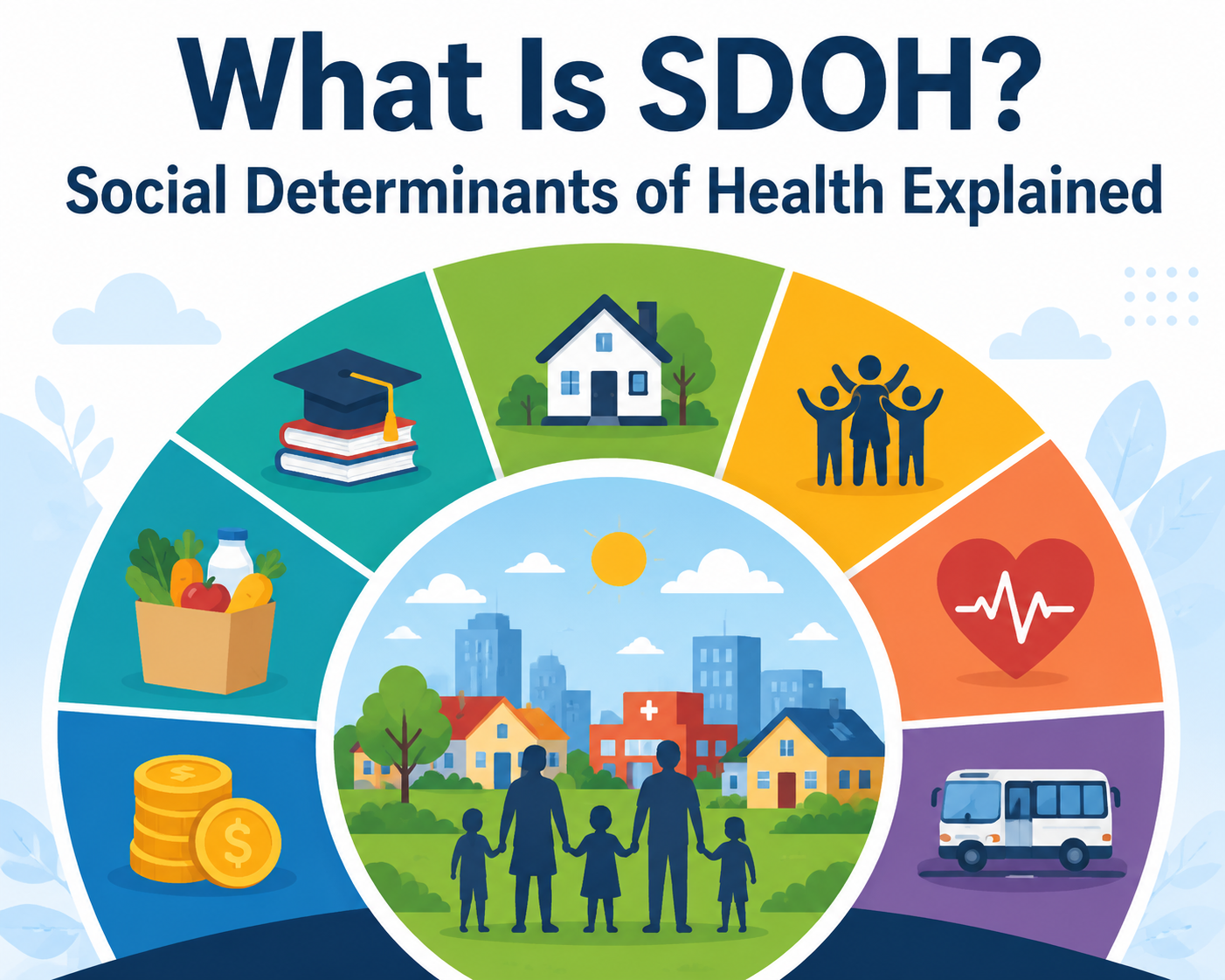
These factors are further separated into five major groups. Each of these frameworks speaks to a different element of health within communities.
Economic Stability: It encompasses income, employment, housing stability and food security. Poverty increases the prevalence of chronic illnesses and restricts access to preventive care.
Access to and Quality of Education: Higher levels of education are associated with improved health outcomes. Much more than access, education mobilises people to take an active role in their health care. It also opens the doorway to jobs with higher income and health benefits.
Social and Community Context: This includes social support, civic participation, discrimination and incarceration. Community involvement boosts mental and emotional well-being.
Health and Access to Care: This domain includes access to care, health insurance, and health literacy. Treatable conditions can turn fatal without access.
Social and Built Environment: This entails quality of housing, access to / availability of heathful food, transportation, pollution. Your place of residence greatly influences how long and how well you live.
How Many Factors Are There?
A frequently asked question is: how many social determinants of health are there? Whether it is simple or complex depends on the frame work in use. The widely used classification from Healthy People 2030 includes five high-level topics. However, each of these areas contains dozens of elements.
A few researchers and organizations take these even further. This results in a list of more than 30 unique social determinants of health. The nature of these can go from air quality, park accessibility, literacy rates and even feelings of social isolation.
So granted, how many unexamined social determinants of health do you write about? No single factor acts alone. Instead, these determinants interact with each other in complex ways.
What Determines Your Health Beyond The Biology?
According to you perhaps the answer is genetics, diet and exercise when it comes to what determines your health. These factors do matter. Howeever, studies have repeatedly demonstrated that social circumstances are responsible for a far greater proportion of health outcomes.
Only over 20% of health outcomes are thought to be the result of clinical therapy. The physical environment, health-related behaviours, and social and economic variables account for the remaining 80%. This is why whole person care is becoming part of the focus for providers, which starts with SDOH.
This implies that your living situation may be a more significant factor than your genetic makeup. That is a startling but well-established fact of modern public health research.
Sociocultural and Sociopolitical Issues in Health
Culture is an important social determinant of health. Cultural beliefs and practices influence illness perceptions, health-seeking behaviors, and adherence to treatment regimens. Sociocultural determinants of health that can affect outcomes include language barriers, traditional health beliefs and distrust in healthcare systems.
Human dimensional factors are another big element. Governmental policies, legislation, and political institutions have a significant impact on issues related to education, employment, housing, and healthcare. Racism, colonialism, and systemic discrimination are the historical roots of many structural and socioeconomic determinants of health.
For instance, communities with chronic underinvestment tend to have poorer health. This is not by accident. This is the direct result of policy decisions that restricted access to resources and opportunities.
It is vital to have an understanding of these structural pressures. This reframes discussions away from individual blame for ill health and towards dealing with systems that produce unequal conditions.
Is Age a Social Determinant of Health?
Everybody asks: is age a social determinant of health? The answer is nuanced. This inherent connection between age and biological factors. Now, the social determinants of health (SDOH) linked with certain life stages fall well within [scope of our graph].
Early Childhood Adversity and the Brain: Children live in poverty with all that comes from it. Loneliness in Older Adults: A Significant Risk Factor for Cognitive Decline and Mortality Access to mental health services — or even a safe spot for some exercise – may not exist for teens in under-resourced communities.
But age as a number is not a social determinant, the social context of the aging absolutely is. SDOH frameworks contain this factor in analyzing the social conditions over the total life course.

What Is SDOH in Healthcare? Social Drivers of Health Screening
In the context of healthcare, SDOH now has a much more practical and pressing significance. Now hospitals and clinics are asking what is SDOH in healthcare, and how do we leverage it to improve patient outcomes.
One key to this is the social drivers of health screening. Standardized methods are utilized by the healthcare workforce to identify patients who experience social challenges such as food insecurity, housing instability, transportation obstacles, and utility shut-offs. These screenings lead to better access of community resources where medical care is only part of the solution.
So if a diabetic patient cannot get access to healthy food, no matter what medication they are given, it will be powerless against the more damaging lifestyle of that patient. Recognizing this social determinant of health allows a care team to refer the patient to food assistance programs that make tangible improvements in their health.
Social drivers of health are now treated as clinical priorities in many healthcare systems. This is a significant change in our mindset of medicine/patient care.
Importance Of Social Determinants of Health
Perhaps you ask yourself: But why on earth social determinants of health matter in the first place? Its simplicity is powerful as well. To ignore SDOH is to ignore the source of all ill health. This is essentially a way to treat the symptoms without treating what caused them.
Most of the health status differences between groups are determined by social determinants: следите за тем, чтобы предложенное вами вышло только в несвязном виде. The health caring needs of communities of color, low-income populations, and rural residents generally poorer outcomes. These differences are not random. They reflect disparities in resources and opportunities accessible.
It is also economically sensible to tackle SDOH. Cost billions each year due to preventable hospitalizations, emergency room visits, chronic disease management. Front ending housing, education and nutrition greatly reduces these later costs.
The COVID-19 pandemic, in turn, only served to crystalize this understanding. The communities with the worst SDOH — overcrowded dwellings, food deserts and lack of access to health care resources — saw many more cases of infection and mortality. That was a painful yet crucial refresher of why social health is so essential.
How to Increase Social Determinants of Health
Understanding what SDOH is and why it matters, is just one step. Which brings us to the question of, how can we improve social determinants of health? The solution is needed at individual level, community level, system and policy.
Policy response : Governments can increase the minimum wage, develop affordable housing, fund public education projects, enhance access to nutritious food programs These policies deal directly with the underlying drivers of ill health.
Community Programs: Community organizations can help with job training, after-school programs, mental health services, and neighborhood improvement projects. These programs facilitate conditions for an individual to actually be able to have good heath.
Changes in the healthcare system: Hospitals and clinics can incorporate screening for the social drivers of health as part of routine care. They are able to employ community health workers and form collaborations with social service agencies.
Cross-sector partnership: Health is not an island. All due respect to schools, employers, law enforcement, housing authorities and health care providers. We argue that only a coordinated approach across multiple sectors has the potential to meaningfully address health-harming social conditions.
Progress requires sustained commitment. Communities most impacted need to be heard, and solutions designed with their involvement.
Global Social Determinants of Health Socialism de la Salud
SDOH is a concept that can be found all around the world. Within Spanish-American countries and communities, the terms are known as determinantes sociales de la salud. Addressing these determinants is one of the key pillars in WHO global health agenda.
All countries exhibit the same type of things. Being poorer, less educated, or facing discrimination and substandard housing predict more poorly than average health. The only issue with that; none of these are uniquely American problems. They are global and universal problems with a local solution.
The burden of reverse translation is higher in low- and middle-income countries; the reality of poor SDOH generally weighs heavily on such populations. Weak health systems and deep social inequalities combined with limited infrastructure provide the double burden of widespread health inequities. One of the defining challenges of our time is remedying these inequalities.
What Social Determinants of Health Should You Track?
You will have seen the term social determinants of health, if you wish to understand what they are there are few things which top research throughout different populations and settings.
Income and Wealth Inequities: Economic inequity is the strongest predictor of health. More income inequality in a society leads to poorer health outcomes for everyone, even the people who are in the middle of the income distribution.
Housing: Having stable and safe housing is the bedrock of health. Homelessness and housing instability are associated with high levels of mental and physical morbidity.
Food access: Food deserts: Areas of your neighborhood with limited or no access to affordable, healthy food are a primary social deterrent of obesity, diabetes and heart disease.
Structural racism: This highlights the systemic barriers that limit access to education, employment, housing and healthcare. The health effects are well-documented and multi-faceted.
Social isolation: It is increasingly widely acknowledged that social contact deficit (loneliness and poor social networks) may constitute a major health hazard Loneliness now rivals smoking in damage to life expectancy.
SocHealth Thinking of Social Health in its entirety
Soc health, also known as social health, refers to a person’s effectiveness in dealing with social situations. It is one of the three dimensions of health — alongside physical and mental health — as defined by the World Health Organization.
Someone with good social health has supportive relationships, a sense of belonging and active participation in the community. The absence of good social health, on the other hand results in isolation, increased stress stimulus, and poor immunity against diseases.
Social health lies in the center of the conversation when we refer to what social determinants of health are. Meaningful Action: Build Our Way to Healthy Communities Building healthy communities is the foundation for creating the conditions which allow all people and the planet to thrive socially, economically, and environmentally.
Conclusion: SDOH Should be a Health Conversation Nonstarter
So, what is SDOH? This brief defines social determinants of health as the entire range of denoting factors—social, economic, environmental and cultural—that influence individuals’ and communities’ health. SDOH encompass much more than hospitals and clinics. This extends into our homes, schools, workplaces and chambers of policy.
The first part of knowing is recognizing what does SDOH stand for — Social Determinants of Health. The real work is doing it. It means transforming the systems and structures that prevent people from living healthy lives. It means investing in communities that have been neglected. And it means understanding that achieving health equity is not a medical issue at all. It is a moral imperative.
Answer: when we address social determinants, it is not that we make people healthier. You raise stronger families, more productive economies and fairer societies. This is why SDOH matters and it must be center stage, every health conversation going forward.
If you are a health practitioner, health and healing provider, health policy maker or a community well being provider then the information about social determinant of health may assists you in your wanted agenda. It begins with asking the right questions — and then acting to ensure that everyone has a fair shot at health.