
Introduction
Shoulder training is necessary if you want to build a strong and well-rounded upper body. But the question many people ask is: What to Exercise With Shoulders to achieve maximum results? Selecting the appropriate muscle groups to train with your shoulders can make a big difference. It not only saves time but also improves performance and ensures that your muscles recover in the right manner. The best exercises for shoulders and traps, the muscles that function best with shoulders, and how to organise your workouts to maximise results are all covered in this book.
The reason why grouping of your muscles will be of importance during a workout
To dive into what to workout with shoulders it is beneficial to comprehend why muscle pairing is important. Patterns of your muscles are working together. When you press overhead, triceps will help in the movement. As you bring a bar down, your biceps and back muscles will be in collaboration. Making your workouts more effective is through training muscles which inherently help one another during a single work out.
In addition, smart pairing minimizes the recovery time. When you work on chest one day and shoulders the following day, you hurt both of the sessions. The reason is that, chest and shoulders have numerous patterns of movement in common. By basing your training on natural muscle interactions, this is completely resolved.
What to Work with Shoulders: The Best Muscle Group Pairings
1. The traditional triceps and shoulder combination.
Among the most sought-after responses to the question of what to workout with shoulders, triceps can be called. This is an excellent idea of a pairing. Any pushing action that you take, be it an overhead press or a lateral raise, involves the triceps to some extent. When you train them collectively it implies that you are already warming them up naturally.
Why it works: The tricep muscles are secondary movers that are activated by overhead presses, Arnold presses, and front raises. When you complete shoulder exercises, your triceps is well prepared and ready. You can then get them to death with some specialized tricep exercises such as pushdowns, skull crushers or overhead extensions.
Sample Shoulder and Triceps Workout:
- Overhead Barbell Press – 4 sets 8 reps.
- Dumbbell Lateral Raises – 3 sets 12 reps each.
- Front Raises -3 sets of 12 reps.
- Tricep Pushdowns – 3 sets 15 reps.
- Overhead Tricep Extension – 3 sets 12 reps.
- Tricep Dips 2 sets x failure.
This combination is time saving and maintains the pushing muscles fatigued collectively. The recovery also becomes easier since you have also devoted the next session to pulling muscles instead.
2. The Shoulder and Traps Together Best Exercises.
The other strong combination is shoulders and traps. The trapezius muscle extends your neck up to the mid-point at the back. It is also worked intensively when performing shoulder exercises particularly when doing the shrugs, upright rows, and face pulls. This renders it as one of the most natural muscles to be trained with shoulders.
An integrated combination of the best exercises to develop shoulders and traps results in the creation of a thick and powerful upper body. This combination is beneficial to athletes, bodybuilders and strength trainers.
The most effective shoulder and trap exercises:
- Barbell Overhead Press- The king of all shoulder movements. It strengthens anterior and medial deltoids and uses the upper traps to stabilize.
- Dumbbell Lateral Raises – Directly hits the medial deltoid. Critical in developing shoulder width.
- Upright Rows – This is a type of exercise that fills the distance perfectly between shoulders and traps. It works both groups of muscles simultaneously.
- Barbell or Dumbbell Shrugs – The last trap builder. Shrugs work out the upper trapezius and gives that thick powerful appearance between the neck and the shoulders.
- Face Pulls -A frequently neglected exercise. Face pulls will attack the rear deltoids and the mid-traps at the same time. They are also effective in improving the health and posture of the shoulder.
- Arnold Press — This is a rotational press, which engages all three heads of the deltoid, through a complete range of motion.
- Rear Delt Flyes – It targets the posterior deltoid, which majority of the people ignore. Training of the rear delt will help prevent injuries and enhance general shoulder development.
By the combination of the exercises that are the best in building shoulders and traps, you create a complete upper body that will look impressive in any angle. More to the point, you develop practical strength which transfers to day-to-day life and athletic performance.
3. Muscle Groups to Train with Shoulders: Chest and Shoulders
There are trainers who suggest that chest and shoulders training should go hand in hand. Both of them are stretching muscles and there is a certain overlap. Nevertheless, this combination needs to be planned thoroughly. When you do heavy bench press first, then your shoulders will be already tired before you start pressing overhead. This increases risk of injury.
It is preferable to prepare shoulders with a level in advance of the chest, or to have the amount of both muscles on the same day moderate. This is a good combination to intermediate lifters following a push-pull-legs program.
When the work of the chest and shoulders is in harmony with each other:
- You have a push day organization.
- You maintain an average total volume.
- You are more concerned with exercising shoulder health such as face pulls and band pull-apart.
4. The top muscle groups to train with Shoulders: Upper Back and Rear Delts
A second great solution to what to exercise with shoulders, is upper back, that is, the rear deltoids, rhomboids and the lower traps. The majority of the population overworks the anterior side of the shoulders and does not work on the back side. This causes muscle imbalance and risk of injury in the long run.
With rear delt and upper back exercises part of your shoulder day, you develop a balanced, healthy shoulder girdle. Physical therapists highly recommend this method as well as strength coaches.
Best exercises in this combination:
- Face Pulls
- Rear Delt Flyes (cable or dumbbell)
- Band Pull-Aparts
- Seated Cable Rows (upper back emphasis)
- Reverse Pec Deck
These movements are not glamorous, but they are absolutely essential. Athletes that do not train the back part of their shoulders tend to experience rotator cuff problems, bad posture, and plateau in pressing strength. Incorporating these exercises in your shoulder workout avoids all that.
Shoulder Workout: What NOT to Pair: What to Workout with Shoulders
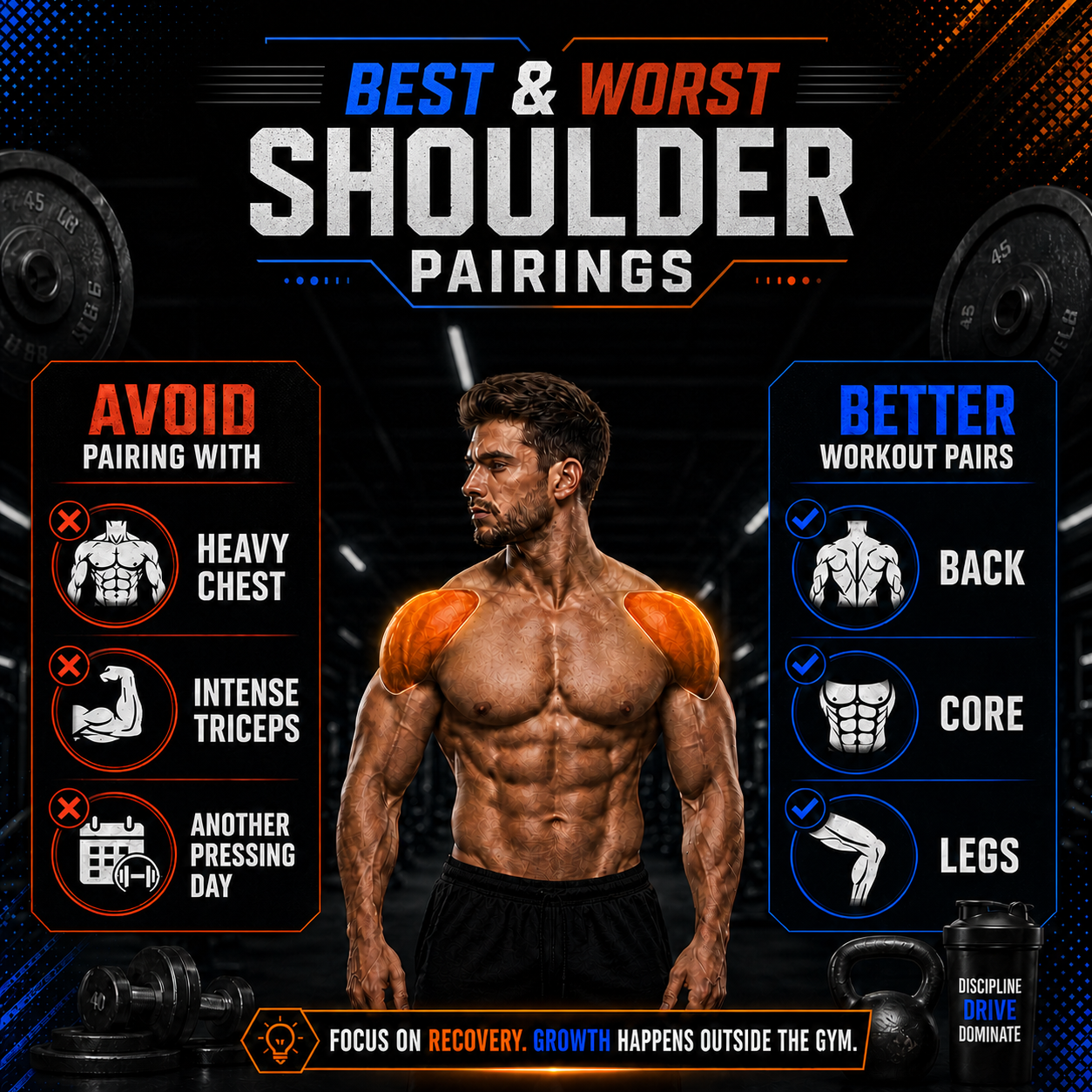
Knowing what to exercise with shoulders also entails knowing what not to exercise. Other combinations of muscle groups are merely not good together.
Shoulders and chest should not be trained on either of the back-to-back days. The two muscle groups require 48-72 hours to rest. Training them too near each other will reduce your performance and retard progress.
Shoulder training should be avoided following a heavy back workout. The rear deltoids and rotator cuff muscles are engaged in lat pulldowns, rows, and deadlifts all of which involve them. The fact that these muscles are already tired when you come into a shoulder session is a significant increase in the risk of injury.
Avoid combining shoulders with legs. It is not dangerous, but it is merely inefficient. The lower body and the upper body have different systems of energy. Holding them separate enables you to train each with optimum intensity.
How to Build a Weekly Plan based on Shoulder Training
Having known what to exercise shoulders with, it will be worthwhile to see how this can be incorporated into a complete weekly plan. Below is an example of a training schedule that can be used to structure training:
The first day Push Day: Triceps, shoulders, and chest.
- Overhead Barbell Press
- Incline Dumbbell Press
- Lateral Raises
- Cable Chest Flyes
- Tricep Pushdowns
- Overhead Extension
Second day: Pull Day: Biceps and Back.
- Deadlifts or Romanian Deadlifts.
- Barbell Rows
- Lat Pulldowns
- Face Pulls
- Bicep Curls
Third Day Legs: Calves, Hamstrings, Glutes, and Quads.
Fourth day: Active Recovery or Rest.
5th day: Concentrate on Shoulders and Traps.
- Arnold Press
- Upright Rows
- Dumbbell Lateral Raises
- Rear Delt Flyes
- Barbell Shrugs
- Face Pulls
Sixth day: Arms: Triceps and Biceps.
Day 7 — Rest
According to this plan, shoulders are trained twice a week (once on a push day and once specifically). Studies are in support of training each muscle group twice a week to achieve optimum hypertrophy. The most effective exercises to use on shoulders and traps are concentrated on Day 5 and are given the due attention they deserve.
Shoulder workout tips that help maximize workouts
Warm Up Right Before Your Very Eyes.
Shoulder joint is one of the most mobile joints in human body. Mobility has its price – it is also one of the most traumatized joints. Shoulder training should always be preceded by warming up. Do band pull-aparts, arm circles and light rotator cuff exercises prior to heavy lifting.
Train All Three Heads of the Deltoid.
There are three heads of the deltoid muscle anterior (front), medial (side), and posterior (rear). The majority of beginners are only concerned with the pressing motions, which mainly strike the anterior head. Ensure that your exercise involves:
- Anterior: Overhead press, front raises.
- Medial: Upright rows, lateral raises.
- Rear delt flyes, face pulls – Posterior.
When all three heads are trained round the entire shoulder in a shape that most people desire to have.
Progress Overload Consistently
In order to develop larger and stronger shoulders, you must be able to gradually add the weight or volume as time progresses. This is referred to as progressive overload. Record your exercises in a journal or program. Goal is to gain a little bit of weight or an additional rep per week. Slow progress is still progress which will result in high returns in the long run.
Neglect not the Traps.
Speaking about the most appropriate exercises to work on shoulders and traps, one can effortlessly focus on the deltoids. Nevertheless, powerful traps add a lot of mass to upper body aesthetics and functionality. Make sure there are at least two trap-specific exercises in every shoulder workout: shrugs and upright rows. The traps help in supporting the neck, enhance posture and support the spine during load bearing.
Prioritize Recovery
Shoulder muscles require proper rest in order to develop. Take at least seven or nine hours of sleep each night. Consume adequate protein – should be between 0.7 and 1 gram of body weight per day. Other factors that contribute to muscle recovery include staying hydrated and eliminating stress.
Errors to avoid when doing Shoulder Day
Using too much weight on lateral raises is a common mistake. Lateral raises are isolation exercises, so using heavy weights often causes swinging and removes tension from the deltoids. For better shoulder growth, use a moderate weight and focus on keeping the medial delt engaged throughout the full range of motion. This is especially important when learning what to exercise with shoulders, because proper form helps you train the right muscles without overloading the joints.
Ignoring rear delts. The majority consists of three to four sets of the front, side, and none of the rear. This results in imbalances and shoulder injuries. Always remember to do rear delt work.
Skipping face pulls. Face pulls are probably the most significant exercise that you can perform in order to take good care of your shoulder. They condition external rotation, reinforcement of the back delts, and reversal of the internal rotation which is a consequence of excess pressing. Include them as the final exercise of each shoulder or push workout.
Failing to warm up the rotator cuff. The rotator cuff refers to a collection of four muscles which are small and they stabilize the shoulder joint. The likelihood of a tear or impingement increases significantly when you load them cold without warming them up. Take five minutes to warm up these muscles before beginning any shoulder exercises.
Conclusion: Build Smarter Shoulder Workouts
So, what to exercise with shoulders? The most obvious response is: triceps, traps and rear deltoids. These muscles co-operate with the shoulders in their normal patterns of movement. It is effective, logical, and efficient to train them together.
The most complete upper body development in terms of exercises is the best exercises for shoulders and traps which include overhead presses, lateral raises, upright rows, shrugs and face pulls. Your programming will be totally devoid of speculation as to whether you are aware of which shoulder muscle groups you need to work on.
Additionally, your clever shoulder training will always be in the shape of a balance—not that you won’t be in a balance—regardless of how you train your shoulders or how you train a section of your body that is divided in two. Trainer front, side and back of the shoulder in equal measures. Warm up properly. Progress consistently. And never miss your traps.
You can now tell precisely what to exercise with shoulders. Use this information, remain consistent and see your upper body change over the next few months.