
Introduction
This is where Open Source Home Automation provides a better approach by offering flexibility, privacy, and freedom of choice. Instead of being locked into a single ecosystem, open-source solutions allow different devices and platforms to work together while giving homeowners more control over their data and smart home experience.
That’s why many are opting for open source home automation. It helps you get on top of things. You select computers and other computing technology. It allows you to select the software. Where your data goes is up to you. No company has the power to literally wipe out your devices at a moment’s notice.
In this guide, we will delve into the meaning of open source home automation, its differences with closed commercial alternatives, and what platforms will be worth your time in 2026. It’s for anyone with a curious mind or a tinkering expert.
What Is Open Source Home Automation?
Open source home automation is home automation software with source code that is publicly available. It is open to all, for viewing, editing, and enhancement. These projects are developed by developers all over the world, often for free, for the reasons of transparency and freedom of the users.
An open source home automation platform will not require you to rely on a single vendor – unlike proprietary systems offered by large technology firms. The software is installed on your own equipment, typically a small computer such as a Raspberry Pi. You then plug it into sensors, switches and smart devices from dozens of different manufacturers.
This leads to a system working as you would like. You don’t have to wait for a company to come out with a feature you want. Can be constructed from scratch, or obtained from another person in the community who has already constructed it.
Why Choose Open Source Smart Home Systems Over Commercial Ones?
Smart home products for the commerce are convenient. But things come at a price when they’re convenient. Many need continual Internet connection. Some sell the data about how you are using it to advertisers. Some will just cease to send updates after a couple of years, leaving your devices to be vulnerable or useless.
An open source smart home avoids most of these problems. So many people are making the switch, here’s why:
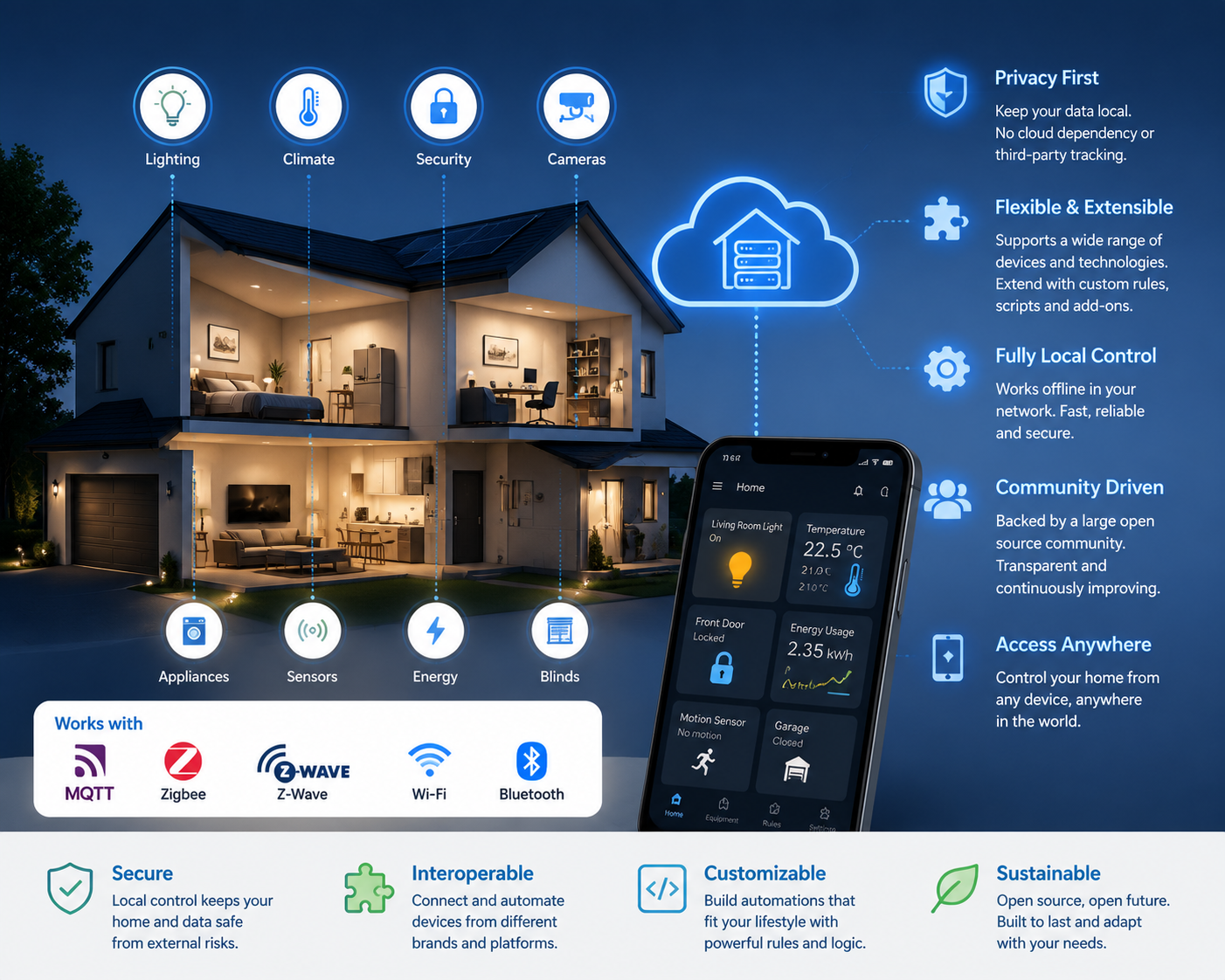
No one knows about your privacy except you. You’re in control of the server, so there’s no need for your data to leave home. No content will be uploaded to a company’s cloud unless permitted.
No forced obsolescence. Products are discontinued from time to time by companies. Now with an open source software, the community continues to maintain projects after the manufacturer’s gone.
Total customization. Whether it’s watering your garden or locking your doors at dusk, anything can be automated. Lastly, if there is no feature, you can create it yourself or another user.
Savings in the long run. Some setup involves purchasing the hardware, but you don’t pay subscription fees like the closed platforms do these days.
The freedom of choice to combine and mix. Open source home automation systems can generally accommodate hundreds of device brands, protocols, and more—such as Zigbee, Z-Wave, Wi-Fi, and Matter. No, you can never be trapped in one ecosystem.
But, of course, there is a learning curve to the freedom. You need to put in more work than you’d have to with a plug-and-play gadget. For many, however, such a sacrifice is acceptable.
Popular Open Source Home Automation Platforms in 2026
The open source home automation marketplace has several leaders today. They each come with their own set of benefits, so let’s discuss them!
Home Assistant is the most popular open source home automation platform.
There’s no doubt it is the most popular home automation platform available that is open source. It can be operated on a Raspberry Pi, mini PC or even an old laptop. It has thousands of integrations, connecting it with virtually any smart device available.
The community is what makes Home Assistant special. There are so many people sharing automations, troubleshooting tips, and custom add-ons on forums, Reddit and Discord servers. Being open source makes it available for regular updates, which will include support for new devices in days of their release.
Local control is also Home Assistant’s focus. Most automation takes place on your local network and your smart home will continue to function when your internet goes down.
OpenHAB: A Flexible Open Source Home Automation System
There’s another powerful open source home automation system – OpenHAB (Open Home Automation Bus). It is written in Java and is extremely protocol and device independent.
OpenHAB is more popular with users seeking to customise deeply and aren’t bothered with the more complex installation process. It allows for rule-based automation, which means that you can create specific rules that define the actions that your devices take when they meet certain conditions.
OpenHAB has a more primitive interface than that of Home Assistant, but for those who are looking for a more “old school” approach with raw control over convenience, OpenHAB is a popular choice.
Domoticz: Lightweight Open Source Domotica
If you are looking for something with less impact, Domoticz should be considered. This open source domotica system is known to perform well on older or less powerful computers. It can accommodate a variety of sensors and switches, making it suitable for smaller installations or basic automation applications.
Domoticz might be missing a few of the shiny bits of larger platforms but it does the job well. Domoticz could be a consideration if you are looking for a simple open source home control solution that does not need to be unnecessarily complicated.
Node-RED: Visual Automation for Any Open Source Home Automation Platform
It’s also worth mentioning, Node-RED is a standalone home automation system. It is a visual programming tool that allows you to create automations by dragging and connecting blocks instead of coding line-by-line.
Many people use Node-RED with Home Assistant or openHAB for more complex automations without having to learn advanced programming. For those who prefer working visually, Node-RED brings home automation to the open source world.
How to Get Started with Open Source Home Automation
It is not necessary to have a computer science degree to set up an open source home automation system. By doing so, you will get a working system in a jiffy.
Step 1: Choose Your Hardware
The majority of people will begin with a Raspberry Pi. It is also very inexpensive, energy-efficient, and supported by most. Old desktop computer or a small NUC type computer can be used, if more processing power is required.
Select your platform in Step 2.
Think about what you want to accomplish before selecting software. Home Assistant is a good option for the biggest community and most integrations. For more fine-grained, rule based control, consider openHAB. Domoticz is a simple resource saving solution.
Step 3: Connect Your Devices
Then, connect your Smart Devices. Zigbee and Z-Wave dongles allow you to use sensors and switches without using Wi-Fi. Many of the smart bulbs, plugs and thermostats that are already on the market can also play in seamlessly, even if they were originally developed for another application.
Step 4: Create Basic Automations First!
Aim for a gradual approach to home automation and don’t try to tackle everything at once. Start small. Light to turn on when door is opened. Change the setting on the thermostat when no one is home. After you’re familiar with the basic ones, add more in-depth ones.
Step 5: Get Connected to the Community.
All the big open source home automation systems have some users. The forums and chat groups are a treasure trove of pre-built automations, troubleshooting problems and hardware recommendations. There isn’t likely to be a problem that you will encounter first.
Common Challenges of Open Source Home Automation (And How to Solve Them)
Any system is not without its flaws and open source home automation is no different. There are some potential challenges and solutions for you.
Steeper learning curve. Open source systems are different to commercial kits in the sense that some background in set up is required. The great thing is that documentation has come a long way and videos tutorials make onboarding a lot easier than it ever was.
Hardware compatibility gaps. Not all devices come with 100% functionality. When purchasing new gadgets, don’t assume they are compatible with your community, look it up beforehand.
Maintenance responsibility. You don’t have to worry about updates and backups since you are responsible for your own server. However, most platforms have an option to do one-click updates and auto-backup tools, so this is not as scary as it sounds.
Network reliability. A local system is dependent on the stability of your home network. Having a good router with wires for critical points can prevent lost commands.
After these initial obstacles, an open source smart home platform typically has few maintenance requirements.
The Future of Open Source Home Automation
Open Source home automation is gaining momentum and looks like it will continue to do so in the future. With the launch of the Matter standard by many major manufacturers, user experience with cross-brand compatibility is becoming much easier. Open source platforms are fast in embracing Matter, which means that users don’t need to sacrifice control over the benefits of standardisation.
AI is also finding its way into home control open source projects. Voice commands and predictive automations are now possible with AI models that are local and respecting privacy, rather than sending what you say to a distant server. The combination of intelligence and privacy is just the type of things many users have been hoping for.
The convenience vs control divide continues to narrow as more manufacturers allow access to their API and push for open standards. Open source home automation is not only for hobbyists. For privacy-conscious and flexible users, it’s emerging as a viable and viable option.
Final Thoughts
The best thing about open source home automation, that big commercial home automation can’t compete with, is real ownership. You control the way your house functions, where your info is stored, and how long your gadgets remain beneficial. Yes, it requires a little more work to set-up. However, the benefit is that it’s your home, your rules, and your smart home.
You can build your system around Home Assistant, openHAB, Domoticz or Node-RED and other tools, the open source community will help get you going. Start by pairing the first device and create a usable automation! After you’ve had the freedom of an open source Home, you’ll never want to return.