
Introduction
Now picture coming home from a long day at work, turning off the lights, lowering the thermostat and blasting your favorite tunes without ever touching your phone. A smart home remote is supposed to do just that. It is designed to make your whole “household” part and parcel of your hand.
The number of smart bulbs, plugs, cameras, and speakers in people’s homes continues to grow, and the demand for a single solution to centralize control keeps growing. A smart home remote can solve this issue. It’s a single application that communicates with all of your devices, meaning you’re not using ten different applications to turn the lamp off.
Let’s dive into this guide and learn what a smart home remote is, why it is essential and how to pick the best one for your household. We will also compare the home remote control to voice assistants and mobile apps, while also providing tips to maximise the use of your set up.
What Is a Smart Home Remote?
A smart home remote refers to a physical or virtual control device that enables a person to control a variety of smart home devices from a single location. You have one remote for all your devices: TV, air conditioner and smart lights!
Most of the latest models are wireless, via Wi-Fi, Bluetooth or infrared. This means they can communicate with almost anything that’s smart in your home, no matter the brand. Some even have touchscreens or voice command inbuilt, turning the remote into a mini command centre of your home.
The great thing about a smart home remote is that it is simple. One doesn’t require any technical skills to utilize it. It only requires a one-time sync of device and the remote does the rest. Saves you time, frees up space and allows for total control with one tap.
Why You Need a Smart Home Remote
Life is busy and juggling with more than one app or TV remote can be cumbersome. The smart home remote connection is the answer. Here are the reasons why it is an essential part of today’s homes.
Convenience at Your Fingertips
The smart home remote eliminates the need to look for the correct remote or unlock your phone each time you want to do something. It is controlled by one device – from lighting to entertainment systems.
Better Organization
With the numerous smart devices in the home, things can quickly become a jumble of apps and remotes. When it comes to making changes, a smart home remote puts it all in one place.
Energy Savings
There are many smart remotes that allow you to set schedules and automations. You can program your lights to go off at a time of your choosing, or your thermostat to change when you’re not home. This will save you energy costs in the long term.
Accessibility for Everyone
Some people aren’t always at ease with smartphone applications, particularly grandparents and others who are not the younger generation. Smart technology is accessible to the entire family with the help of a smart home remote control with physical buttons or a simple screen.
Types of Smart Home Remote Control Devices
Remotes aren’t all alike. Knowing the different types will assist you decide what home remote control you need.
Universal Smart Remotes
They are devices that use infrared, Wi-Fi and Bluetooth technology. They can operate your TV, sound system, air conditioner and other smart devices all with one remote. The universal remote is perfect for households that have a variety of old and new electronics.
Voice-Enabled Smart Home Remotes
Some smart home remote controls include inbuilt microphones. It’s as easy as telling it to do something – e.g. “turn off the bedroom lights” – and it’s done. This is a convenient way to take pictures when you’re in a hurry or have your hands busy.
App-Based Remote Controls
Many people use smartphone apps as their home remote control, which isn’t technically a device, but rather a software app. Some of these apps can be used for multiple brands and provide greater customization, like creating custom scenes or automation routines.
Smart Hubs with Remote Functionality
Some smart hubs can be used as remotes! They can be plugged in to your home Wi-Fi infrastructure and allow you to control everything from the lights to video surveillance. These are ideal for bigger properties that support numerous devices.
How to Choose the Right Smart Home Remote
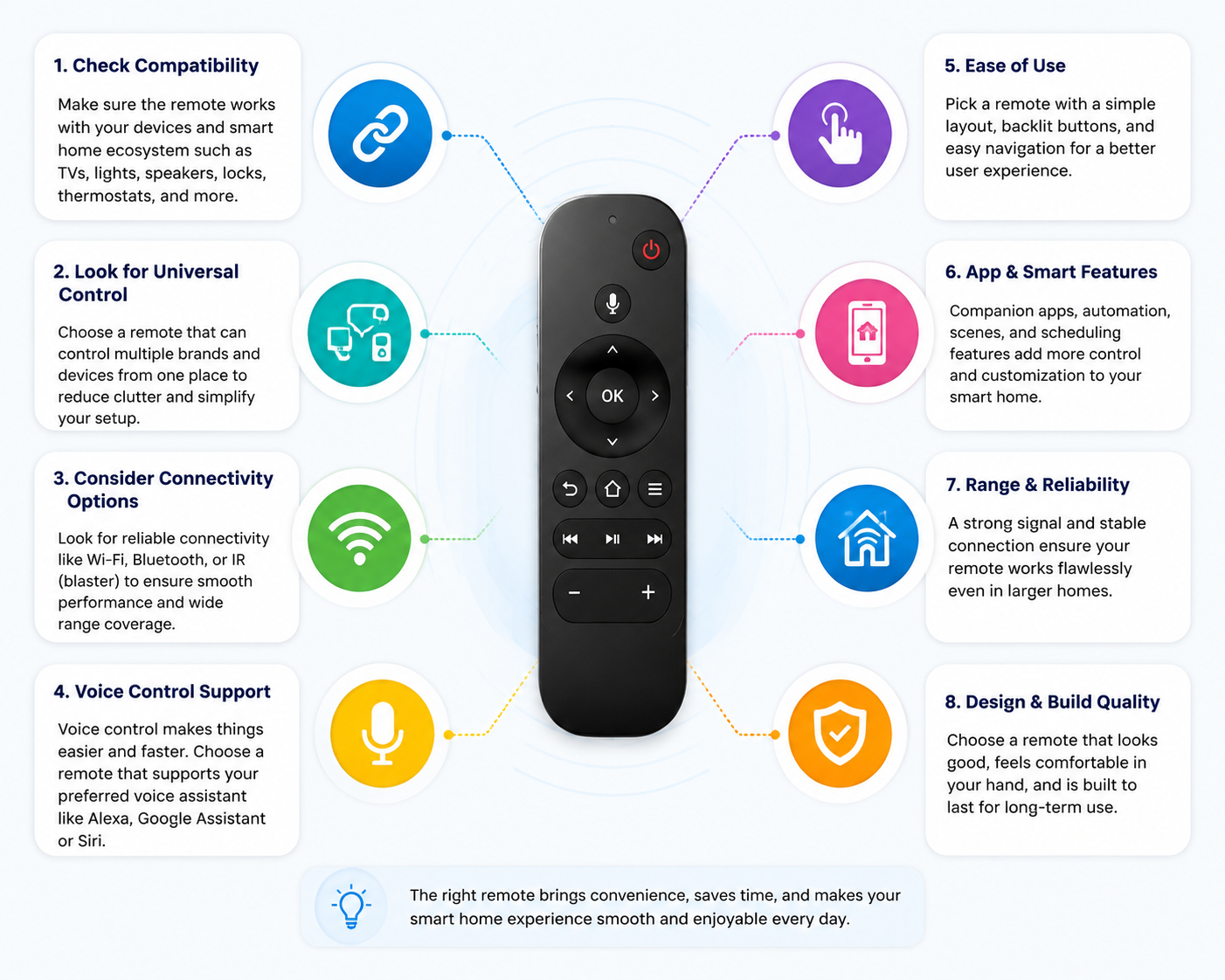
Picking the best smart home remote depends on your specific needs. Here are some of the things to keep in mind when purchasing.
Compatibility with Your Devices
Make sure the remote is compatible with the brands and protocols you already use, like Zigbee, Z-Wave or Wi-Fi. If it is not compatible with the other remotes you already have, then it will be of no use to you, regardless of how chic it appears.
Ease of Use
Search for an easy-to-use, intuitive smart home remote. The longer the menus are, the more people feel frustrated when they don’t know what to do with the complicated buttons.
Range and Connectivity
Some remotes use an infrared signal (must be in a straight line to use). Others come with Wi-Fi or Bluetooth which provide greater range and flexibility. A remote that can be used at a distance, and has a strong wireless signal, is likely a better choice if you have a big home.
Battery Life
It’s important to consider the battery life of these remotes because they are going to be used a lot. Select a device with a long battery life, or use batteries that can be replaced easily.
Integration with Voice Assistants
There are many smart home remotes available that work in tandem with Alexa, Google Assistant or Siri. If you are already using one of these platforms, then you might want to choose a remote that is compatible with it for an even smoother experience.
Setting Up Your Smart Home Remote
It’s generally easy to get started with a smart home remote. Make sure of everything by following this simple procedure.
- Unbox and charge the device. Most smart remotes require a charging-up before they can be used.
- Download the companion app, if required. Depending on the remote, the initial configuration might require an app.
- Connect to your Wi-Fi network. This helps the remote to communicate with the smart devices.
- Connect device(s) sequentially. Use on screen instructions to pair each smart product with the remote.
- Create custom scenes. For instance, create a “movie night” environment which automatically switches to “low” lighting and shuts on the TV.
- Test everything. Test each device to ensure proper response to daily use of the remote.
After you’ve it installed, your smart home remote will make everyday life so much easier. You can change the settings in a matter of seconds, without having to open multiple applications.
Smart Home Remote vs. Voice Assistants: Which Is Better?
As more and more people consider a smart home, they often question whether they should opt for a smart home remote or use voice assistants like Alexa or Google Home. The reality is, each has its own advantages, and they frequently complement each other better.
Voice assistants come in handy when you are cooking or your hands are occupied. But, they may have trouble in noisy settings or will misinterpret instructions. On the other hand, a smart home remote provides accurate and touch-sensitive control. You push a button and the action occurs immediately and there is no chance of misinterpretation.
Many families use both for optimum results. Voice control for simple instructions; smart home remote for detailed control and privacy. The combination of the two provides flexibility and reliability, regardless of the situation.
Benefits of Using a Home Remote Control for Daily Life.
A good home remote control is more than just an on/off control. It really enhances the living experience of your home.
Families with small children can benefit as a physical remote is much easier and safer for children to operate than a smartphone. Familiar relatives of older children also have an easier time than dealing with apps. Even visitors can use basic features, such as ‘Lights On’ and ‘Lights Off’, without requiring to install anything into their phones.
A smart home remote also enhances your home’s security, as well as its convenience. Some of them offer a range of options to see if doors are unlocked or if lights are on, ensuring you feel secure whenever you are out of the home.
Common Mistakes to Avoid When Using a Smart Home Remote
With the best smart home remote, there are some common mistakes that can reduce the use of the smart home remote. To get the best out of the device, avoid these pitfalls.
- Skipping firmware updates. Patches are released by manufacturers often to enhance the performance and to add new features. If you don’t pay attention to them, your remote may become outdated.
- Overcomplicating automations. Automations are great, but having too many complicated setups can be problematic for troubleshooting later.
- Ignoring compatibility checks. Before buying these new smart devices check if they are compatible with your remote.
- Placing the remote in a poor location. For a remote that uses infrared technology, ensure that it is in the “line of sight” of your devices to operate properly.
You’ll be able to enjoy a better and more predictable smart home experience by avoiding these pitfalls.
The Future of Smart Home Remote Technology
Smart home remote technology is continually changing. AI has also been incorporated into the capabilities of remotes, which can now learn your patterns and recommend automation for you. For example, if everyone knows that you’re the type of person who turns off the lights at 9 pm, a smart home remote could recommend that you set an automatic lighting routine for that time of day.
There are also more remotes with matter compatibility, a new industry standard to ensure smart devices are compatible across brands. The next home remote you use will probably be capable of controlling a larger number of products, from all manufacturers.
Final Thoughts
The smart home remote makes the world of connected devices easy. You don’t have to toggle between apps or search for the right remote, you have one solution that can handle all your lighting and entertainment needs.
The smart home remote will continue to evolve as technology advances, making it even smarter, more user-friendly and even more indispensable for contemporary life. By investing in one now, you will have a more connected, convenient, and comfortable home tomorrow.