
Introduction
Entering a gym for the first time can feel intimidating. With rows of machines, free weights, cardio equipment, and people performing unfamiliar exercises, it can be difficult to know where to begin or which Different Gym Workouts are right for you.
The reality is that there is no one “best” method of training. Rather, there are a number of workouts that are performed in the gym and each of them has a particular objective. Some build strength. Others improve endurance. Some are looking for flexibility, others are looking for pure muscle growth. Recognizing these various exercise programs can help you pick an exercise strategy that is right for your body as well as for you.
We’ll discuss the key workout categories at the gym, how to plan a workout for real results, and how to create a workout routine that will keep you on track for long-term success.
Why Trying Different Gym Workouts Matters
The routine ought to be a routine, not a rut. Having one routine all the time isn’t only dull but not efficient either. Your body is very adaptive to chronic stress. The same workout to improve the lift, after some time, doesn’t provide any further increase in the lift. This is known as a plateau and one of the most frequent conditions to cause people to stop training entirely.
Switching up the gym routine stimulates your muscles in new ways. This maintains good progress and limits the potential of overuse injuries. It also adds some fun. A diverse workout program is a way to avoid the same mind-numbing Jim workout every day of the week.
Also, various workouts have different effects on various systems of your body. Strength training increases the bone mineral density and muscle mass. Cardio enhances the condition of the heart. Mobility work helps to keep joints safe. Having all these components together forms a complete, balanced fitness plan.
Main Types of Workouts at the Gym
It helps to grasp the big picture of the various types of exercises that are performed in the gym before you begin workout splits. The majority of exercises in a gym session are in one of these buckets.
Strength Training
Strength training involves using resistance, such as from a dumbbell, barbell, machine or body weights, to add power and build muscle. This is the source of most fitness training programmes and with reason. It stimulates metabolism, strengthens bones and enhances appearance and function.
Cardiovascular Training
Cardio workouts raise your heart rate and improve endurance. Running, cycling, rowing and swimming are all examples of this. By training the heart, cardio can help to burn fat and maintain heart health, along with a proper nutrition plan.
Functional Training
Functional training mimics real-life movements like squatting, pulling, pushing, and rotating. Enhances balance, coordination and overall strength. These include kettlebell exercises and bodyweight circuits.
Flexibility and Mobility Work
The combination of stretching, yoga, and mobility drills completes a full fitness program. They minimize risk of injury and increase range of motion, thus enhancing the effectiveness of all other forms of exercise.
High-Intensity Interval Training (HIIT)
HIIT is a type of training that alternates high-intensity movements with brief recovery. It burns calories quickly, is very efficient, and can be performed with nearly any equipment or none.
The five mentioned categories are the bedrock of most workout programs that make a difference. The trick is to mix them in a manner that suits your objectives and timetable.
Best Workout Split for Strength
For strength-building, choosing the right workout split is just as important as selecting the right exercises. Different Gym Workouts offer several effective split options to help you build strength and achieve better results.
Full-Body Workouts
Full-body workout – trains all major muscle groups in one workout. This is suitable for those new to exercise or those who can only exercise 2-3 times a week. As you’re getting each muscle group more often, it’s important to focus on recovery and consistency.
Upper/Lower Split
The split is upper body and lower body days. A good balance, sufficient volume yet still providing 4 days of training per week. For strength after the beginners phase many lifters prefer this workout split.
Push/Pull/Legs (PPL)
Popular split that splits workouts into pushing, pulling and leg day. PPL is a great program for intermediate to advanced lifters that train 5 to 6 days per week, as it enables a higher volume per muscle group.
Body Part Split (Bro Split)
This is the classic method that focuses on a specific muscle group on each day, for example Chest on Monday, Back on Tuesday. It is a popular practice among bodybuilders but it needs to be practiced for a longer duration of weeks to be effective.
Whether you’re splitting into your headphones or earbuds, it’s the consistency that counts more than the perfection. The ideal split for strength is the split that you can do for the long haul.
Best Workouts for Each Muscle Group
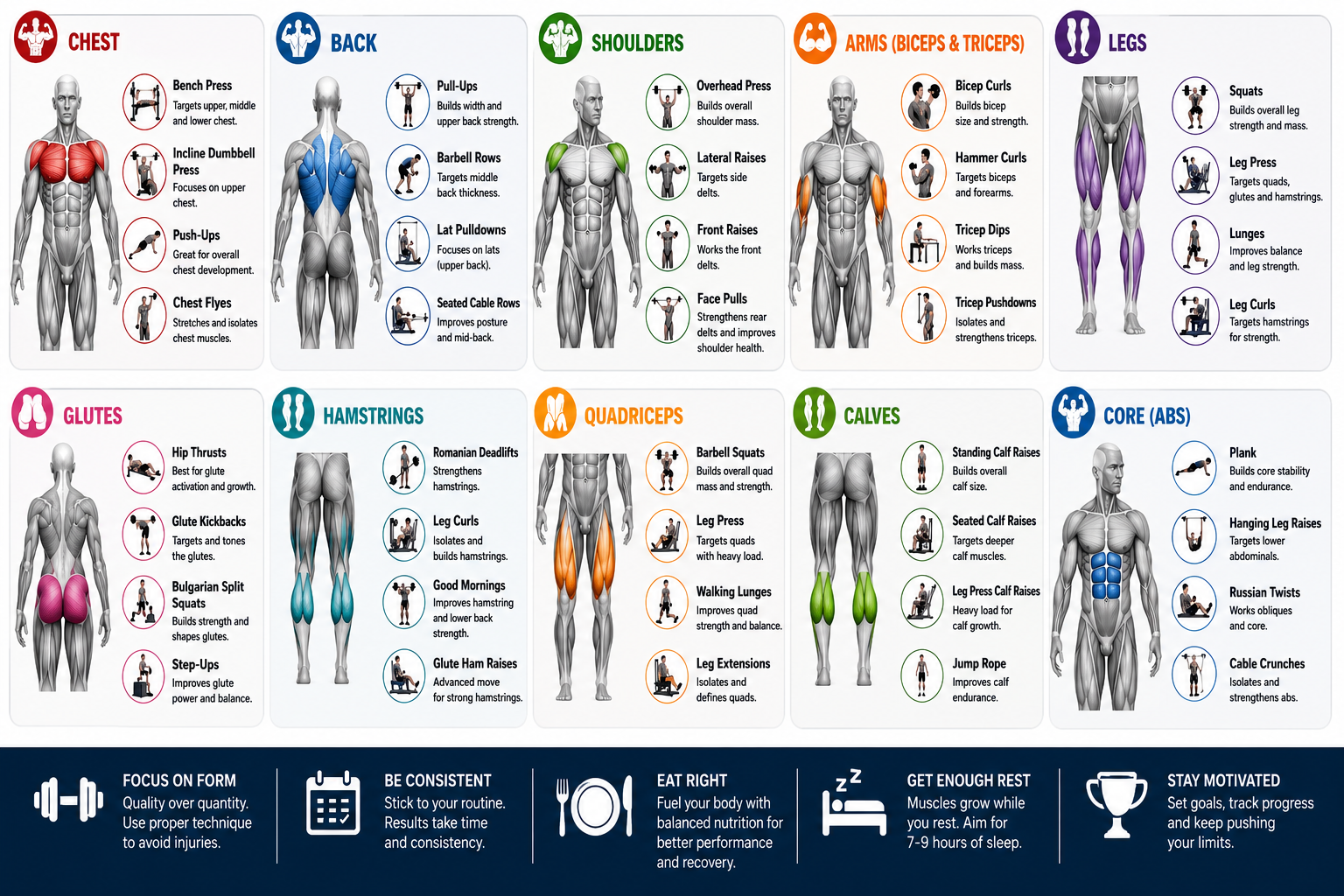
Knowing what exercises to perform on each muscle group will help you build well-rounded and effective exercises. Let’s take a brief look at some of the best weightlifting exercises for the major muscle groups.
Chest: Bench press with a barbell, pushups and incline dumbbell press work on the front of the chest and front shoulders.
Back: Pull-ups, barbell rows and lat pulldowns work width and thickness (plus posture).
Legs: Squats, deadlifts, and lunges are still some of the most effective exercises to develop lower-body strength. There are few exercises that engage more muscles at once.
Shoulders: Overhead presses and lateral raises help develop well-rounded, strong shoulders and upper body stability.
Arms: Bicep curls and tricep dips focus on smaller muscles which help with pressing and pulling.
Core: Planks, hanging leg raises and cable rotations build the foundation of all the rest of the lifts.
These rotations throughout the week make sure that no muscles are ignored and the workout sessions are also kept interesting with regards to lift.
Different Workout Days: How to Structure a Week
This is one of the worst things people can do is training without a plan. The right workout week structure can mean the difference between progress and spinning your wheels.
Here is a sample of a week with different workout days:
- Monday: Upper-body strength training
- Tuesday: Lower body strength training
- Wednesday: Active recovery or light exercise (cardio)
- Thursday: Push exercises (chest, shoulders, triceps)
- Friday: Pull exercises (back, biceps)
- Saturday: Legs and core
- Sunday: Rest
This system is designed to be a balance of strength, recovery and cardio throughout the week. Depending on your time and experience, you can alter the number of training days. Three to four days of workouts per week is a good amount for beginners, and 5 to 6 is good for advanced lifters.
Different Workout Styles Beyond the Weight Room
Not all workouts are performed with a barbell. Variations of exercises will make training fun and can target fitness aspects not covered by conventional lifting.
Circuit training is a combination of strength and cardio training and is performed in fast paced, timed rounds. It’s great for fat burning and conditioning.
The CrossFit training combines metabolic conditioning with Olympic lifting and gymnastics moves. It’s hardcore but it’s good for total fitness!
By engaging in controlled, low-intensity movements, Pilates exercises strength to the core and enhance posture.
Whether you’re taking spin or boot camp, group fitness classes are good for accountability and social motivation to keep you consistent.
Having a variety of exercise programs in your training week, even from time to time, helps to avoid boredom as well as to stimulate the body in a new way.
Building Fitness Training Plans That Do Work
So, how do you turn all this information into fitness training programs with real, lasting results? You must have a definite objective. What are your goals: strength or fat loss, endurance or overall health? Your workout plan, as well as the frequency and intensity of your workouts, depends on your goal.
Then, make sure it’s progressive overload. This is incremental in terms of weight, reps, or intensity over time. If this isn’t followed, even the best exercise routines for each muscle group will lose their effectiveness over time.
The same amount of attention should be given to recovery. Resting, sleeping and rest days are used to repair and strengthen muscles. Not recovering is the quickest route to a lack of progress or injury.
Last but not least, keep a record of the workouts. Taking notes on sets, reps and weights will help you notice patterns of performance and make modifications in your best workouts as time goes on. The things that worked well the previous month may need to be adjusted when your body modifies itself.
Choosing the Right Workout for Your Goals
There are a variety of gym workouts to choose from—how do you decide? First, tell him how you’re doing and how much time you have available. Someone with no experience trying to do a push/pull/legs split 5 days a week might get tired easily. However, a man who is very experienced and only performing full body training every other week may not achieve the gains he was hoping for.
Consider combining approaches. For instance, you can do strength training 3 days per week with 1 day of cardio and 1 day of mobility. This combination contains the most important components of the physical fitness program and doesn’t require too much time.
Keep in mind, the exercises that get results are the ones that you actually perform consistently, regularly, over the course of months and years. While the right programming can be great, it doesn’t matter if it can’t be sustained.
Common Mistakes to Avoid
With a strong strategy in place, some errors can make it difficult to get ahead.
Warm ups are often neglected, resulting in potential injury and less performance in the main lift session. Some people try to lift heavy weights but fail to learn proper form, which results in injury not in building strength.
An over-training situation is a common pitfall too. A more is not necessarily better. If the muscles do not get the rest they need, they are not capable of repairing the micro-tears and thus cannot grow. This can manifest as tiredness, irritability or lack of progress, despite persistence.
Finally, many—give up on a routine too early. The results of various types of exercise in the gym are not visible until after 8-12 weeks. Generally speaking, patience is more effective when combined with consistency rather than any type of particular exercise selection.
Final Thoughts
Don’t go through the motions of exploring new gym workouts, just to follow a trend or to mimic someone else’s workout. It’s about finding a balance of strength training, exercising with a focus on purposeful movement, and recovery in your body, time, and goals.
If you’re doing the best workout split for strength, changing workout days or just trying out a different workout style to keep you motivated, consistency is the key. Begin with the basics, see how it goes and modify accordingly.
By taking the right steps, you’ll surpass the chance of guessing and create a workout program that truly provides positive, long-term outcomes – one workout at a time.