
Introduction
As the business world moves faster, companies use dozens of different software tools to enable their operations. Sales teams use CRM systems. Finance departments use accounting software. Inventory management tools used by operations teams. However, productivity takes a hit and mistakes multiply when these tools don’t communicate with one another. And this is precisely where the implementation of a business integration platform comes into play.
Enterprise integration platform A business integration platform unifies all your applications, data and processes into one ecosystem. Eliminate manual entries, automate workflows, and give teams a single source of truth. Integration: No matter if you are a start-up in rapid growth mode or a large enterprise, understanding how integration works can contribute to transforming the way you work.
When you finish reading this guide, you’ll know what business integration platform is, how it works, why it matters and how to choose the one for your needs.
What Is Business Integration Platform
A software integration tool is a solution that allows various apps, databases, and systems to form communication and exchange the data seamlessly. You are like a bridge between your tools, only digital now. Instead of having to export a spreadsheet in one app and manually importing it into another, an integration platform carries out that work automatically, in real time.
In modern business, integration software has evolved past mere data transfers. It allows complex workflows, real-time syncs, API management and event-driven automation. Some platforms provide pre-built connectors for widely used solutions, including Salesforce, SAP, Shopify, QuickBooks and hundreds more.
There are a few common types:
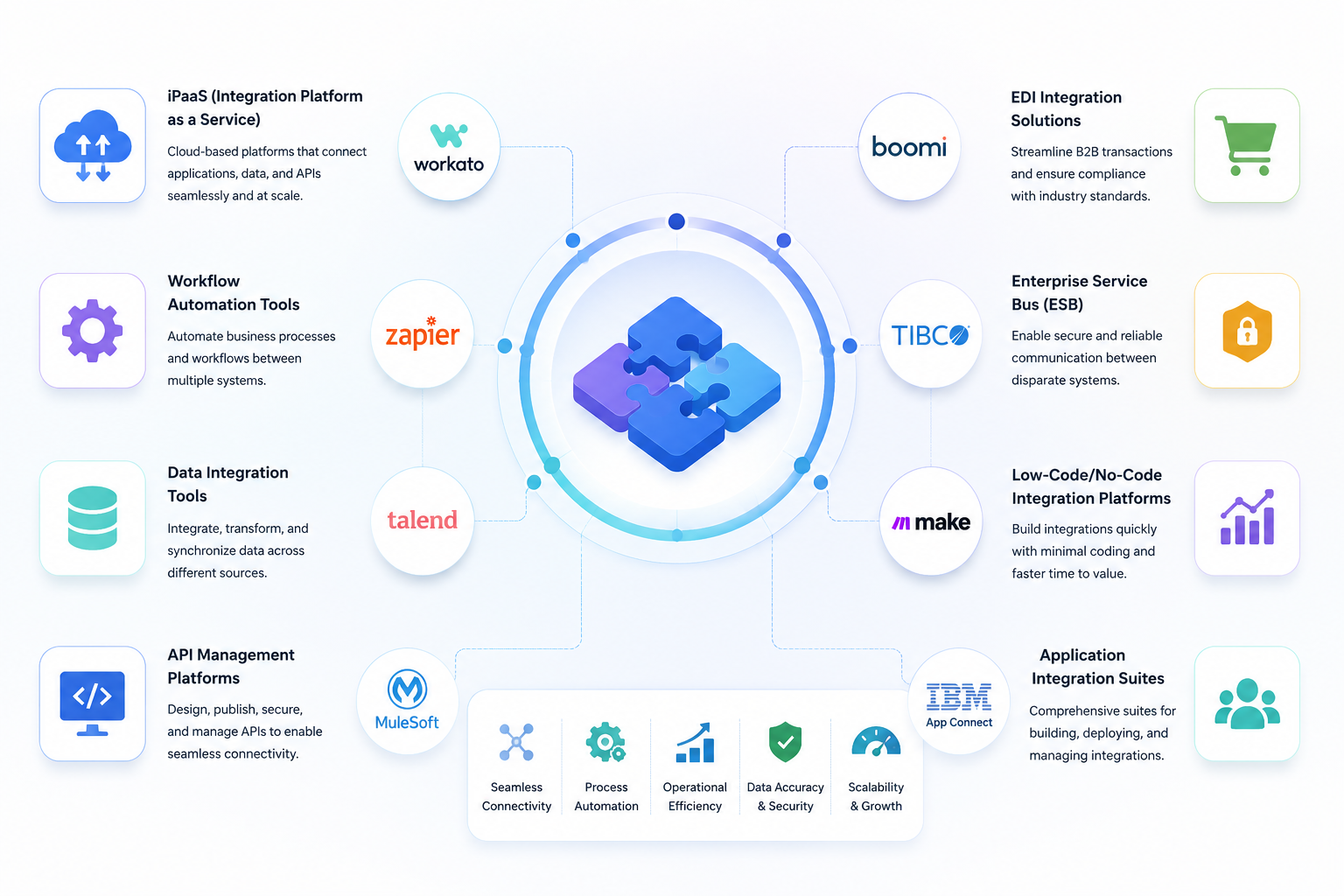
- iPaaS (Integration Platform as a Service): Cloud-based platforms that allow SaaS applications to be integrated online rather than through heavily on-premise frameworks.
- Enterprise Service Bus : This is a more traditional type of middleware There want to connect two on premise system usually big companies are using this.
- API MANAGEMENT PLATFORMSFocus on the creation, management and protection of APIs
- ETL Tools (Extract, Transform, Load) :Used mostly for data integration and analytical pipelines.
Every type has a specific purpose it serves. Your business requirements will help you with the right approach.
Why Your Business Should Have A Digital Integration Platform
Data silos: The one common obstruction to the growth of every business. Without integration, teams spend their time manually transferring information between systems leading to mistakes, and frustrating experiences for customers. This is where a digital integration platform helps on all fronts.
The key reasons businesses buy integration are as follows:
Removes Manual Data Entry No one likes entering data manually, because it is a slow process that comes with a lot errors. Data passes automatically from tool to tool when your systems are integrated. Your sales team has closed a deal in the CRM, and the billing system sends out an invoice immediately. No one has to copy and paste anything.
Integration‑driven automation to accelerate workflows. What would previously take you hours to do now takes seconds. That speed advantage compounds over time and gets you a serious competitive advantage.
Better Data Accuracy If data lives in a single connected ecosystem, there exists only one version of the truth. Disputes between teams about which spreadsheet is the correct one are a thing of the past. Everyone has access the latest information, and everybody works from same.
Improves the Customer Experience Customers want speedy and accurate service. Integration makes sure that your support team and warehouse team see the same order history. This results in quicker resolutions and delighted customers.
Grows With Your Business As your business grows, so does your tech stack. An effective business integration platform would grow as per your requirements. Integrating a new tool into your ecosystem is as simple as adding a connector, as opposed to having to rebuild everything from scratch.
Critical Features Things Which You Should Look In Business Integration Software
However, there is more than one business integration software. First, evaluate a platform like this against the essential features before you do platform selection.
Pre-Built Connectors and Integration Templates
Top-tier platforms provide hundreds of connectors ready to use. These enable you to quickly integrate some of the most popular tools with little to no custom code. Seek connectors which match with your present technologies, such as the CRM (CRM), ERP (ERP), e-commerce platform, MARKETING TOOLS and communications apps.
A low-code or no-code business integration platform
Integration platforms have more and more moved toward offering visual, drag-and-drop interfaces. Tools like these — which come either no-code or low code — are popular, because they allow other people who do not have technical skills to build and maintain their own integrations. Which minimizes reliance on developers, subsequently reducing deployment time.
Real-Time Data Sync
Cancelling or updating an order means data must change immediately on all systems that interface with it for some businesses. The others would work with scheduled syncs. Ensure that the platform supports the sync frequency demanded by your operations. E-commerce, customer support, financial reporting need real-time sync.
Error Handling and Monitoring
Integrations occasionally fail. The right business integration platform will include comprehensive logging, alerts, and automated recovery from errors. You should instantly be notified when something breaks, and the platform needs to enable you to resolve the issue rapidly.
Security and Compliance
Data is precious when going through an integration platform. Seek platforms that provide end-to-end encryption, role-based access controls, and compliance certifications (eg, GDPR, HIPAA or SOC 2). Security cannot be viewed as secondary.
Scalability and Performance
Your data volume increases, and your platform should scale with it. Before committing, test with a load on the platform. Inquire about uptime guarantees and infrastructure redundancy from vendors.
Leading Integration Software Tools on the Market
The integration software solutions market is quite competitive. There are several prominent players, each bringing different strengths to the table.
MuleSoft Anypoint Platform
MuleSoft is a powerful enterprise integration platform here. Enables API-led connectivity, along with built-in tools for both on-premise and cloud integrations. Mulesoft is preferred by large enterprises with complex requirements.
Boomi (Dell Boomi)
Boomi is a well known integration platform as a service ( iPaaS) that offers ease of use and extensive connector library. It provides robust data quality tools and is a popular option for mid-market companies searching between flexible and user-friendly.
Zapier
For small businesses and personal usersZapier is the tool for integration. You can automate tasks without the need for heavy infrastructure using Zapier which has thousands of simple “Zaps” workflows that trigger actions when an event occurs and connect over 6,000 apps. Zapier is not as deeply enterprise-ready as MuleSoft or Boomi, but they are the king of ease and access.
Microsoft Azure Integration Services
Azure provides these comprehensive set of integration tools for businesses that have already made investments in the Microsoft ecosystem. These consist of Azure Logic Apps, Azure Service Bus, and Azure API Management. They have combined together to form a robust digital integration platform inside the Azure cloud environment.
Workato
Workato fast gaining traction as enterprise automation and integration software A powerful combination of a no-code interface along with the ability to automate workflows. Its strengths are particularly pronounced in HR, finance and automating IT operations.
MakeHQ (formerly Integromat)
Make → Make is a versatile budget-friendly tool for small to medium businesses. It has a visual workflow builder and great customization flexibility, Developers find the depth it offers satisfying, while non-techies enjoy its straightforward user interface.
How to Evaluate Integration Vendors
Integrating vendors requires a detailed study to choose from them. The wrong selection not only wastes your time but money and frustration as well. Now use the following criteria to help you make a decision.
Understand Your Use Cases Before you talk to a single vendor, write down how you expect the integration to work and what features or functionality are crucial for your business. Which systems you will be integrating. List Workflows That You Want to Automate Upon what basis would your quantify the pain you are in right now? This will give you some clarity to ask the right questions
Total Cost of Ownership Licensing fees are just the starting point. Take into account implementation costs, how much time will be needed for training and the work required for continuous maintenance, and finally —the cost over time of adding new connectors as they become available. Many low upfront costsrelatively affordable looking platforms with prohibitively expensive pricing once your integration footprint grows.
Test Vendor Support When an integration goes down, you want help immediately. Inquire about support tiers, response times and resources available from vendors. Good documentation, a healthy user base, and fast customer support are all essential.
Demand for a Proof of Concept Before committing to signing any contract, request the vendor provide you with access to their platform using one of your actual use cases. A proof of concept shows how the platform will truly work in your environment and not just what is has been pitched like in a mediocre sales demo.
Contact Customer References Speak to organisations at similar scales and in the same sector to your own. Inquire about their experience with the platform, vendor support quality, and whether at the end they go back to choose that platform.
Standard Disable most Interesting Use Cases of a Business Integration Platform
Having real-world applications enables you to realize the integration value more clearly. The following are some of the most popular use cases.
E-Commerce Operations Retailers connect their Shopify or WooCommerce store to their inventory management software, shipping provider, and accounting software. It updates stock levels, triggers a shipment and an invoice when your order is done. Everything happens without human intervention.
Customer Relationship Management Sales teams combine their CRM with email marketing tools, lead capture forms and customer support systems. A prospect fills out a form, they automatically get created in the CRM and receive a personalized welcome email sequence.
HR and Payroll Automation HR team integrates their Human Resource Information System (HRIS) with payroll software, benefits providers and directory services. When a new employee comes on, their information is automatically shared with all the necessary systems. Your onboarding process is quick and accurate.
Financial Reporting Finance teams connect their ERP with BI tools. Dashboards ד3 incorporate revenue data, expense reports and budget information automatically. Instead, CFOs have a real-time view of the finances without waiting for those manual reports.
Key to Successful Implementation of Software Integration Software
There may be feature, however deploying software integration Software is a hard project. Planning, communication and continual management are the key to success.
Phase 1: Begin with high-value integrations Don’t attempt to integrate everything at once. Focus on the two or three integration that will provide you greatest near-term benefit. Create those first and test the results, then scale.
Engage Your Stakeholders Early Integration projects lose momentum when they don’t have a connection to the key users from Start. Add the teams that leverage on the integrations daily Their involvement informs better solutions, and leads to faster adoption.
Document Everything Carefully document your integration architecture, data mappings and workflow logic. Good documentation triages troubleshooting and makes it much faster when something breaks — and eventually something will.
Monitor and Optimize Integration is not a set-and-forget solution. Regularly check your integrations. Keep an eye on sync times data quality and error rates. Because your integrations must evolve as you grow.
The Evolution of the Business Integration Platform
The landscape of integrations is changing quickly. Many trends are influencing the future of how companies connect their systems.
Integration Powered by Artificial Intelligence Artificial intelligence is gradually proving to be a prominent player in the overall ecosystem of integration platforms. AI can recommend integration mappings, identify outliers in data flows, and even create automations based on natural language commands. This makes it more accessible to integrate for non-technical user
Event-Driven Architecture Much of the industry is shifting towards an event-driven integration approach, where systems respond to real-time events versus traditional batch processes that are run based on a schedule. This method provides quicker, more dynamic operations.
API-First Design Modern day businesses work backward with APIs. It simplifies the integration process and scales better. It is increasingly significant to have a business integration platform that supports API management natively.
Hyperautomation Hyperautomation is a term coined by Gartner which integrates integration, RPA (robotic process automation), AI and machine learning as a combination to automate business processes where possible. This is something that proactive businesses are investing time in today.
Conclusion
No longer is a business integration platform an extravagant resource reserved for the large corporate enterprise. It has become an operational necessity for businesses that want to operate efficiently, scale successfully and provide excellent customer experiences. Connecting your applications and automating your workflows frees your teams to work on what really matters — scaling your business.
There is no one-size-fits-all best business integration software; it will depend on your specific needs, tech stack, and budget. Consider your options carefully, engage your stakeholders, and start with the integrations that provide maximum business value. When you feel the strength of a completely connected electronic community, you’ll ask yourself how you everywhere made it with out.
Take the first step today. Current systems audit, the larger integration gaps, review the digital integration platform options in front of you. This will be one of the most cost-efficient investments you make.