
Introduction
It’s all about handling a number of tasks simultaneously while running a business today. There’s never a dull moment, from handling emails, creating invoices to maintaining leads and booking staff. This is where business automation systems come in to alter all of it.
This article will explain what business automation systems are, how they operate, and why they are becoming more and more popular among businesses each year. No matter if you are a small business or a corporate executive, this article will demonstrate to you how automation can save your time, cut down your expenses, and propel your business towards a quicker growth trajectory.
What Are Business Automation Systems?
Business automation systems are tools and technologies which can do repetitive, time-consuming tasks without human interaction. Your software can do this for you, accurately and on time, every time, rather than you manually entering data, sending follow-up emails or creating weekly reports.
These systems are used to link various aspects of your business together. They automatically communicate information from one point to another using rules, triggers, and workflows. For instance, if someone enters a contact form on your website, an automation system can prepare a new lead in your CRM, send a welcome email, designate the lead to a salesperson, and schedule a follow-up task on the salesperson’s calendar — all in seconds.
Automation is already being employed in all types of businesses. Human involvement can be replaced by automation in the following core process of retail, healthcare, finance, logistics and marketing sectors. The aim is always to accomplish more with less effort and do it again and again.
Automation is crucial for businesses today
The automation of a business is something that is not accepted by many business owners because they believe that it is too complex or expensive. But the truth is, it’s just the opposite. Today’s business automation software solutions are easier to use and cheaper than ever. The price of not automating only keeps increasing.
Let’s look at the reasons for automation in the here and now.
The most important asset is TIME. An hour of manual data entry, generating reports or copying and pasting the data between tools, is an hour your team is not using to be more effective in strategy, sales, or customer relationships. That’s the time that automation brings back.
People are expensive! Errors occur when someone is doing repetitive work. If a wrong number on an invoice or a missed reminder e-mail costs you a client, what could be better? Almost all of this risk can be eliminated with automation.
Competition is fierce. This means that your competition is probably already utilizing some sort of business automation. If you continue to do things manually, you’re already behind. Automation keeps you on top of the game — and ahead of the curve.
Scalability becomes easier. Manual processes work slow as your business expands. Increasing the number of people to manage volume is costly. No headcount is required for automation to scale with you.
Key Areas Where Business Automation Systems Make a Difference
1. Marketing Automation
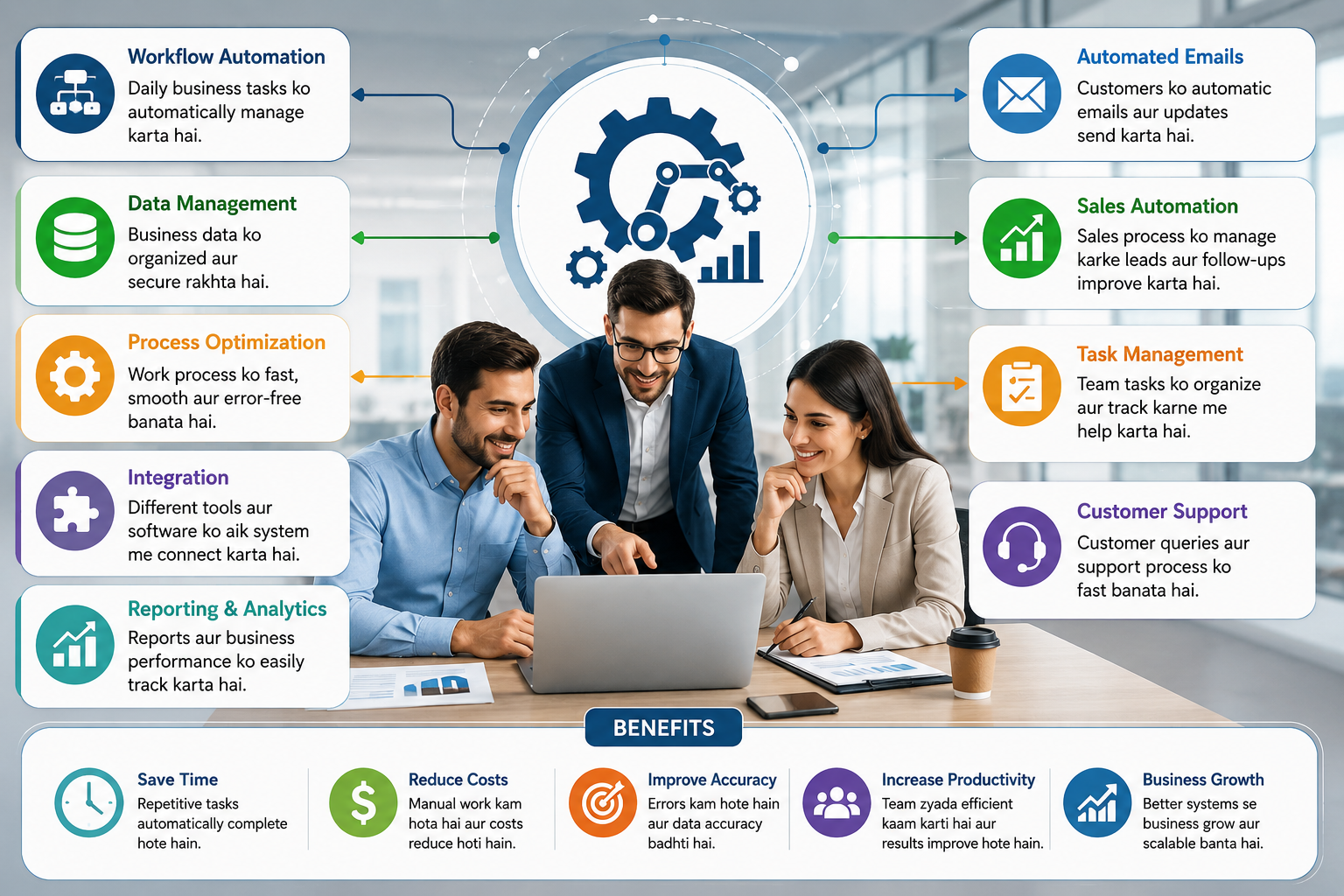
One of the greatest areas of business that needs automation is marketing. In Marketing, a robust business automation strategy can nurture leads, send personalized email campaigns, post on social media, track customer behaviour and score leads — all without having to lift a finger.
You can configure a sequence of emails to be sent to a new subscriber over 7 days or more, for instance. When they click on a product link, the system makes note of their interest in the product and puts them in a targeted campaign. This level of personalisation, which was previously only achievable by big businesses, is now available to smaller companies. With the proper tools, even a small business can do it today.
2. Sales Process Automation
A lot of time is spent by sales teams on tasks that are not the actual work of selling. It takes time to update CRM records, write follow-up emails, schedule calls and create proposals, all of which can be time-consuming when you are trying to sell. Business automation systems resolve the issue by automating those admin tasks.
Automation can send out a proposal template, alert the manager and send a reminder to follow up when the deal steps through a new stage in your CRM. Your salespeople spend more time with your customers and selling, rather than filling out paperwork.
3. Finance and Invoicing
Manual invoicing is time consuming and prone to mistakes. A company that specializes in business automation, specialized in financial automation, could assist you in generating invoices automatically, send payment reminders, reconcile accounts and produce financial reports at regular intervals.
This will allow your finance team to dedicate more time to analysis and strategy, and less on routine work. It also benefits your cash flow by getting your invoices out quicker, and with the reduced number of late payments due to reminders.
4. Human Resources & Onboarding
The process of hiring and onboarding new employees is a lot of paperwork and coordination. Business automation systems can send offer letters, collect documents, assign training modules, set up accounts, and schedule orientation — all the time as soon as a brand new hire is added to the system.
This ensures a uniform onboarding process each time, and saves your HR team from administrative burden.
5. Customer Support Automation
There are no timeouts.Quick response is a must. Automation enables you to provide them. Chatbots are capable of answering frequently asked questions around the clock. With ticket systems, issues can be automatically forwarded to the appropriate department. Follow-up survey can be automatically sent out when a support case closes.
You’re able to go to your support team when there are complex issues and routine ones are resolved immediately. Your customer’s satisfaction increases and your staff is less overwhelmed.
How to Choose the Right Business Automation Software Solutions
Not every automation tool is the same! The wrong platform can be a time and money drain. The factors you need to consider when assessing business automation software solutions.
Ease of use. Basic workflows should be straightforward and not require a developer to configure. Search for drag-and-drop builders and visual workflow editors that can easily be used by everyone in your team.
Integration capabilities. Your automation system should interface with the tools you already use, such as your CRM, email platform, accounting software, project management software, and others. The more integrations you have, the more powerful your automation will be.
Scalability. Select a system that will expand as a business grows. If it works for 10 employees, it should work for 100 employees. Find flexible pricing and enterprise options that can grow with you.
Support and training. It goes without saying that good software has good support. Seek out platforms that provide support during setup, tutorials and customer service response.
Security and compliance. Your automation system will process sensitive data of your customers and your business. Ensure that the platform meets the industry security protocols and data protection laws.
Some of the most common business automation software options are HubSpot, Zapier, Make (formerly Integromat), Salesforce, ActiveCampaign and Microsoft Power Automate. They are different in their needs and business size therefore, choose them according to your needs.
Working With a Business Automation Company
Certain companies choose to work with a committed business automation company instead of establishing them on their own. It is suitable for complex processes, when your team is not technically equipped, or if you need quick results.
A business automation firm brings expertise, tools and experience to the table. They will review your current workflows, understand where they’re going wrong, suggest the appropriate platforms, and create bespoke automations to suit your business.
The benefit is that they are quick and accurate. You do not have to wait months to get things working, you have a working system in weeks. The drawback is the price, but quality work comes at a price. The ROI is typically earned back rather rapidly though, particularly for businesses of medium to large size.
Consider companies that can provide case studies of success in your industry, have clear project timelines, and have support services available after implementation when selecting a business automation provider.
Common Mistakes to Avoid When Implementing Business Automation Systems
No matter how good the business automation system is, it can fail if it is not implemented properly. Some of the following points apply as pitfalls.
Automating broken processes. Your existing processes are faster – for better or worse – with automation. If a process is inefficient, then automating it will simply make the process inefficient. Optimize and map your processes before automating.
Attempting to automate all at once. Start small. Start by automating one or two workflows that can have a significant impact. Take advantage of experience before growing. Trying to get everything done all at once can cause confusion and resistance in your team.
Neglecting your team. Staff may be worrying about job security due to the introduction of automation. Tackle this issue directly. Discuss how automation takes the boring jobs that nobody likes to do, allowing humans to concentrate on more valuable, creative and strategic work.
Skipping testing. Test your automations before they go live! If a workflow is set up incorrectly, it may alert the wrong email to thousands of customers or delete crucial data. Test all scenarios before switching to ON.
Forgetting to monitor and maintain. Automation isn’t “set and forget it. BPRs evolve over time. Check the automations occasionally to ensure it is still aligned with your business processes.
The Future of Business Automation
The automation of business is far from coming to a halt. Indeed, it is speeding up. AI is now being added over top of automation platforms, thus what’s being called “intelligent automation. AI can identify patterns, make decisions, manage exceptions and optimize workflows on its own.
For instance, some AI tools have the ability to classify incoming emails, scan invoices for details, forecast likely customer conversions and compose initial drafts of reports. This puts business automation systems into a whole new league of capabilities.
Those companies that invest in automation now will be more ready for this future with AI. They will already have clean data, systems that are connected and flows that are automated, which AI can build upon.
Getting Started With Business Automation: A Simple Action Plan
First Steps? This is a simple plan to begin implementing business automation systems at your organization.
Step 1 – Review existing processes. List all of the repetitive tasks that your staff does on a regular basis. Keep track of the time each one takes and of any errors that are made.
STEP 2: Prioritize by impact. Concentrate on the activities that take longest or that make most mistakes. These are a list of the best automation candidates you have.
Step 3: Select Equipment. Investigate business automation software solutions and find the one that best suits your needs and budget. Test platforms before you sign up with them, by taking advantage of free trials.
Step 4: To begin with, one workflow. Build and test one automation before moving on to the next. Recognise and celebrate small achievements; build momentum.
Step 5: Expand gradually. When the first workflow has been working well, choose the next workflow and automate it. Gradually add to your automation stack.
Step 6: Measure results. Monitor savings in time, mistakes and revenue. These numbers can be used to support additional investment in automation.
In conclusion, Business Automation Systems are no longer a luxury or an option, but a necessity.
Manual and repetitive work is a thing of the past. Automating systems for business are not reserved for big companies. Businesses must be competitive, efficient, and profitable in the rapidly changing business landscape, and they need these to do so.
You can use a company that offers business automation services, purchase business automation software solutions, or create your workflow with affordable tools, but the bottomline remains, do something that will involve you in business automation. Time and cost savings can be substantial for even the smallest of automations.
Businesses that adopt business automation today will be the ones that will succeed in the next decade. Don’t play catch up with your competition. Start automation, start scaling and start winning.