
Introduction
In today’s business world, you have to perform dozens of tasks at one time to run your business. Emails pile up. Approvals get stuck. Reports take time to be compiled – hours. That’s why the vast majority of businesses are looking to the best workflow automation software to get repetitive tasks out of their way.
From small startups to large enterprises, the right operations automation software can save your team hours a week. It can also minimize mistakes, expedite approvals and ensure that your entire business runs smoothly. We’ll dive into all the details of workflow automation, starting with the definition and moving on to the best platform for you.
What Is Workflow Automation Software?
Workflow automation software enables you to create, execute, and monitor automated workflows within your business. The software is able to pass the tasks from one to another effortlessly without you having to do it yourself. It activates the actions depending on the rules you have set. For instance, if your customer completes a form, the software can generate a task, send an e-mail back to the customer and alert your sales team — at the same time.
Business workflow systems are based on this fundamental concept. They bring together your apps, your people and your processes into one smart, automated flow. This translates to quicker work, reduced errors, and more time for productive work.
Why Your Business Needs Workflow Automation
First, it explains why now is such an important time for automation before getting into the specifics of tools. Manual processes tend to create the same issues for businesses: delays in approvals, deadlines missed, and human error costs. These problems quickly sum up.
The reasons that more companies are investing in best workflow management software:
- Time Savings: Automated with no need for time. Instead you can work on creative and valuable work with your team.
- Less errors: Manual data entry has the tendency to cause errors. With automation, this is no longer a risk as data is always consistent across systems.
- Better visibility: Most platforms provide you with dashboards to monitor all workflows as they unfold. You always know what’s done and what’s yet to be done.
- Scalability: Automated systems grow as your business expands. It isn’t necessary to hire additional employees simply to manage additional processes.
- Cost efficiency: Staff time is reduced, therefore operational costs are reduced, over time.
These are tangible and tangible advantages. That’s why, in recent years, every industry has seen an explosion in the demand for automation platforms.
Key Features to Look for in the Best Workflow Automation Software
There are different types of tools. While you are considering your choices, keep these factors in mind.
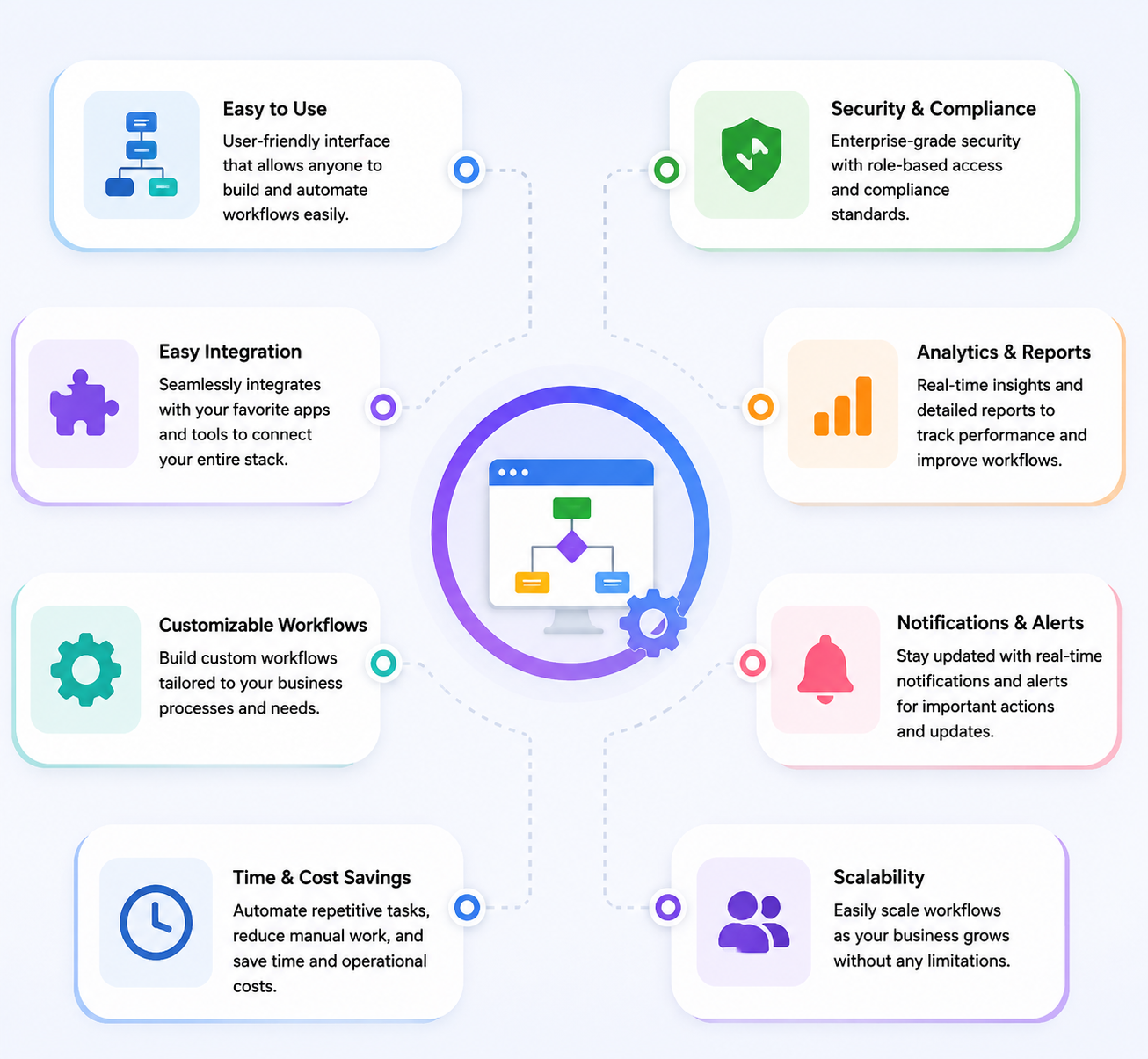
Ease of Use
The best tools will have a drag and drop builder, as well as a visual builder. There should be no need to write a single line of code to design workflows. It’s particularly important for non-technical teams that have to develop and modify processes rapidly.
Integration Capabilities
Your automation platform should integrate with the software you are already using, such as your CRM or email service, project management application, or accounting application. The more integrations that you have, the more powerful your workflows will be. Seek platforms having hundreds, if not thousands, of pre-built connectors.
Conditional Logic and Branching
Not all processes go through the same steps. A good best automation software will allow you to establish circumstances: “If this occurs then do that”. This enables your workflows to be flexible for real world situations.
Reporting and Analytics
If you’re not getting anywhere in your workflows, you’ll need to find out about it. Seek platforms equipped with integrated reporting features to monitor performance, identify bottlenecks, and make continuous improvements.
Security and Compliance
Security is a matter for regulated industry in particular. Ensure that the platform has role-based access controls, audit trails, and meets regulations such as GDPR or SOC 2 compliance.
Top Workflow Management Software Options in 2025
We shall take a look at some of the most popular tools on the market today. They are used by thousands of workflow automation companies and businesses across the world.
1. Zapier — Ideal for small businesses and non-technical users.
One of the world’s most used automation platforms. It allows to integrate more than 6,000 apps and easy to create the automated workflow called “Zap.” No coding skills required. Its user interface is simple, user-friendly and quick.
Zapier is ideal for small businesses that want to automate simple, multi-step processes. For instance, you can save email attachments to Google Drive, add new form submissions to a spreadsheet, and send a message to your team on Slack — in one zap. The free plan is quite generous and the paid plans are scalable based on the usage.
Ideal for: Solo entrepreneurs, small companies and teams new to automation.
2. Best for Complex, Visual Workflows
Make is a very robust visual automation platform that enables you to create very detailed workflows. While Zapier provides a visual view of only the specific parts of your process that it supports, Make presents the whole process visually in a flowchart. All the steps, connections and data transformations are visible at a single glance.
Construct complex logic and make handles of it. It includes features such as loops, filters, error handling, and real-time data processing. It is also compatible with hundreds of apps. Make is a serious contender for best workflow automation software if you’re looking for something to deal with advanced use cases.
Ideal for: Developers, agencies, teams with complex and multi-branch workflows.
3. Microsoft Power Automate — Best for Microsoft 365 Users
Power Automate is a logical choice for businesses that use Microsoft products. It works seamlessly in Teams, SharePoint, Outlook, Dynamics 365 and across the Microsoft ecosystem. One of the most potent enterprise operations automation software solutions.
There are two types of flows: cloud-based and desktop.Power Automate can be used for both cloud-based and desktop flows. This allows you to automate tasks on the web, and record and replay tasks on your home desktop. It also comes with features such as document analysis and form processing that are powered by AI.
Ideal for: Mid to large businesses already running Microsoft 365 or Azure.
4. Monday.com is the best option for project and team workflow management.
Monday.com began as a project management software. It has developed into a comprehensive business workflow system over time. Now it has strong automation capabilities that will take action when changes happen in your boards. For instance, if a task gets set to “Done” in Monday, the task will automatically notify the following person, be assigned to a different board, and an email will be sent.
The platform is very visual and easy to work with teams. It will be best suited to workflows that are tightly coupled to project tracking and team collaboration.
Ideal for: Companies looking for project management and automation in their single solution.
5. Kissflow — Best for Enterprise Business Process Management
Kissflow is specifically designed for enterprise level business workflow solutions. It emphasizes business process management (BPM) and enables you to set up formal, structured business processes for HR, finance, procurement and other departments. As opposed to lighter tools, Kissflow is meant to be used for approvals, compliance and large-scale operations.
It has a user-friendly no code interface, extensive analytics, and robust security features. In addition to that, Kissflow also provides forms and reports and an integrated app builder. It’s among the most extensive top workflow management software applications for large organizations.
Best suited for: Enterprises with formal and auditable business processes.
6. n8n — Best Open-Source Automation Platform.
If you want complete control, n8n is an open-source platform to self-host that lets you develop automation. It has hundreds of integrations and gives you the ability to build custom JavaScript in your workflows. It can be installed on your own servers, so your data remains 100% private.
Technical teams who require flexibility aren’t interested in paying per task or using a third-party cloud should use n8n. One of the most cost-effective best automation software solutions for teams who have the capability of developing it themselves.
Perfect for: IT developers and technical teams when they require absolute control over their data and processes.
How to Choose the Right Workflow Automation Platform
It might seem like there are a ton of workflow automation companies that have great tools, but how do you choose which company is right for you? It’s easy to use system to help with decision making.
Begin with your use case. Do you need complex business processes with multiple steps or simple task handoffs? Simple needs are met by tools such as Zapier. Make, Power Automate or Kissflow might be necessary if the need is complex.
Consider the technical expertise and abilities of your team. For non-technical users, no-code tools are a great option. Some of the developer-friendly platforms (such as n8n) give more power but come with higher setup requirements.
Check your existing tech stack. The right automation tool for your business is the one that works well with your existing tools. Always check the integrations list before committing.
Consider your budget. The majority of platforms have free trials. The more that you use, the more that you have to pay. Consider the long-term price as well as entry point.
Try it out first and then make a decision. There are nearly all free trials provided by each and every significant platform. Use it. Create a genuine workflow while trialing. This allows you to get a feel for whether this tool is a good fit for your team.
The Future of Workflow Automation
The future of best workflow automation software is now — and it’s fueled by AI. Machine learning is now employed to recommend workflow enhancements, identify mistakes and even create workflows from natural language descriptions. Just type in: “When a new lead fills out a form, create a new user in CRM and send an email to welcome them” and the AI does the rest.
This enhances the ease of access of operations automation software. It’s no longer necessary to know all the technical jargon. Tools take care of some of the thinking for you.
Meanwhile, businesses are heading toward the end-to-end automation. Not just single tasks, but whole departments are being automated: from lead generation to customer onboarding to finance reconciliation. Most progressive workflow automation vendors are creating these types of integrated systems.
Conclusion: Choosing the Right Workflow Automation Software for Your Business
Workflow automation is no longer a luxury: It’s a competitive edge. The best workflow automation software can help your business function more quickly, efficiently, and accurately. It saves your team from mundane duties and helps them concentrate on the growth areas.
The key takeaway is that you should start the automation, whether you’re using Zapier for its simplicity, Make for its power, Microsoft Power Automate for its deep integrations, or n8n for its flexibility. Automating a few of the steps can save your team a few hours each week.
The top automation platforms are the ones that operate seamlessly without causing disruption and allow your team to focus on their tasks. Assess your requirements, try out some of the options and create workflows that really resolve your actual business issues.
You’ll be rewarded for the time that you put into setting up automation today, for years and years.