
Introduction
Let’s delve into the meaning of AI at home, how it functions, and its significance. We also explore the various types of AI devices for the household, their advantages and future prospects of the AI smart home.
What is the meaning of AI in homes?
In the case of home, AI typically refers to technology that performs learning, adaptation, and decision making on your behalf. This isn’t automation, but it’s more than simple automation. Automation is a timer that lights a light at 7 PM each day. But, an AI home system that learns your daily routine and adjusts the lighting to fit the schedule, and changes behavior if your schedule changes — that’s artificial intelligence.
AI home automation is more than just pre-established rules. It leverages data, machine learning, and sensors to gain insight into patterns and act intelligently. It’s as simple as making your home more comfortable, efficient, and secure without having to deal with every detail in person.
The Rise of AI Home Automation
In the past decade, AI home automation has moved at a rapid pace. It began with simple smart plugs and lights, but has since grown into fully fledged AI-run home systems, which can manage security cameras and kitchen appliances.
The growth is being fueled by several factors. First, the price of sensors and microchips has fallen drastically. Second, with the speed of the internet increasing, devices can communicate with one another more easily. Third, cloud computing makes high-power AI processing possible for even the smallest of devices.
This has made more homeowners more interested in investing in smart homes that feature AI. The industry estimates the global smart home market will increase at a healthy rate until the end of this decade. People desire houses that are working for them, not work for them.
Common Types of AI Smart Home Devices
There are many kinds of AI smart home devices available today. All of them do different things but they all have one thing in common; they are all smart in enhancing the experience at home.
AI-Powered Smart Home Devices for Comfort and Convenience
One of the most sought-after AI-smart home devices is a smart thermostat. The Google Nest Thermostat, for example, adapts to your temperature needs with time. They self-regulate the heating and cooling without using a lot of energy by themselves.
Another widespread use is smart speakers with voice control such as the Amazon Echo or Google Nest Hubs. AI can make music, remind you, respond to inquiries, manage other connected gadgets and even place online orders from these AI devices in your home. They are very easy to use, as they have an understanding of natural language.
Smart systems of lighting are also in this category. They learn when you’re home, adjust the brightness according to the time of day and even can sync with your mood or the weather outside.
Artificial Intelligence Devices for Home Security
AI has had a significant impact on security. Artificial intelligence has been used to differentiate a person, a pet and a car. This will cut down on false alarms and taking your focus away from what matters.
Smart doorbells that use facial recognition can notify when someone they don’t know is at your door. A smart home system with AI can also track the activity in your household and around your house. The system can alert you instantly in case of any unusual activity, which means when someone is moving at an unusual time like 3 AM when no one is really awake.
Some AI houses even make use of forecasting analytics. Whether it be a smoke detector warning in advance of a potential fire or a water sensor identifying a slow leak, the system can alert you to a potential issue before it becomes a problem.
AI in Homes for Energy Management
Another use case for energy management is great. Home automation, combined with artificial intelligence, allows the tracking and control of how much energy each device consumes. Smart home systems can help manage energy-intensive activities, such as washing dishes or powering up an electric vehicle, during non-peak demand periods to save money on electricity costs.
AI can help predict energy production by the solar panels based on the weather forecast, and then schedule the use of your home’s energy system. This is a type of smart energy management which can result in considerable annual savings.
How Artificial Intelligence in Home Automation Works
Once you know the workings of artificial intelligence in home automation, you can make better choices when establishing your home automation system.
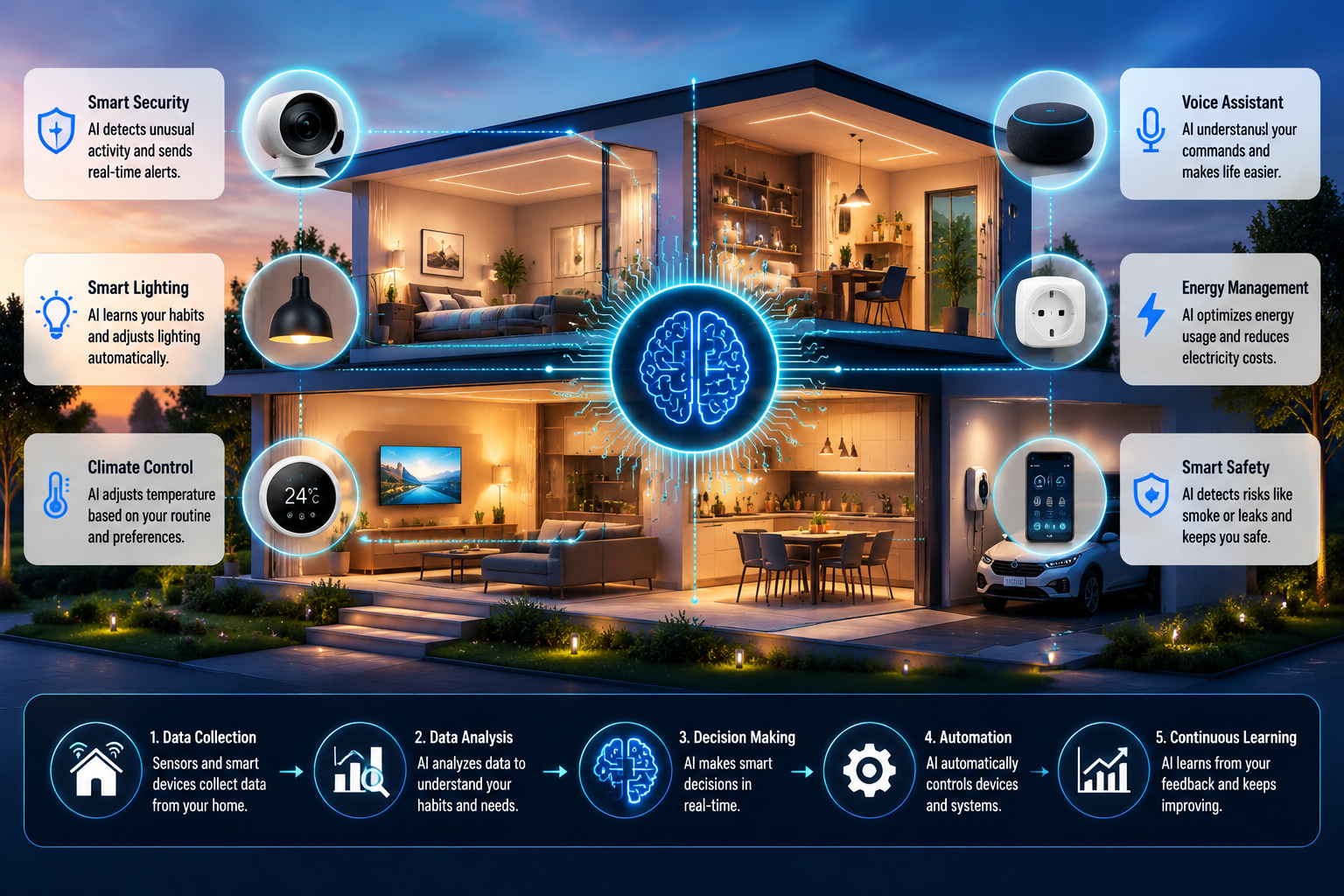
The majority of AI smart home products link to the web, and interact via a hub or cloud-based platform. They gather information from sensors, such as temperature, motion detection, sound level and others. This information is used to feed into machine learning algorithms that detect patterns and make predictions.
For instance, your AI home system may detect that there’s a person who enters the kitchen and activates the coffee maker every weekday around 6:30 AM. After some time, it gets to know this pattern and begins to roast the coffee automatically before you are even out of bed. The more data that the system gathers, the smarter it becomes.
A number of smart home devices and platforms today also work with each other. Your lighting system can communicate with your security system. Your thermostat can communicate with your smart blinds. This interconnection is what enables a true AI house to be possible.
Benefits of Living in an AI-Powered Home
AI has tangible and easily understood advantages for the home. Let’s take a glance at the most pivotal ones.
Convenience: Repetitive tasks are done automatically with AI-powered home devices. You save time in running your home and live it!
Energy savings: Artificial intelligence homes are more intelligent when it comes to saving energy. They save energy by only heating, cooling or lighting rooms you use.
Security: AI home systems provide 24/7 coverage for your home. They can identify threats quicker and warn you as soon as they are spotted, providing more peace of mind.
Accessibility: AI at home can be transformative for seniors and people of all ages with disabilities. Automated tasks and voice-controlled devices help people to live independently.
Energy bill reductions: The initial price tag of smart home devices powered by AI can be high, but the potential for energy bill savings in the long run can make up for it. Reduced manual services: The cost of the equipment used to create an AI smart home can be high, but the long-term savings on manual services can offset that investment.
Challenges and Concerns About AI in Homes
However, the use of artificial intelligence in home automation has its own set of challenges. There is a great deal of privacy concern. Personal data – conversations, routines, sleeping patterns and much more – are gathered in vast quantities by many of the AI-powered home devices. The information is frequently stored in the Cloud and left unclear what individuals own it and how.
Cybersecurity is also a fact of life. If not secured properly, a smart home equipped with AI can be open to the threat of hacking. If the AI home system is compromised, attackers could have access to your cameras, locks, and other sensitive devices.
Compatibility is another one of the challenges. The smart home is a market where there are several competing platforms and standards. It’s not always easy to get the devices to work properly together, and they may not be compatible across manufacturers, making it more challenging than expected to create a smooth integration for an AI house.
Last but not least, there will be the cost factor. A lot of AI smart home gadgets are costly. Many may not be able to invest in a “full house” and fear a widening gap between those with and without these technologies.
The Future of AI Home Systems
AI home systems are an exciting prospect for the future. There are a few trends in the making that will form the next generation of AI-driven homes.
Integration with generative AI: AI assistants are getting more conversational and context-aware. The next generation of AI-powered home devices will be able to hold longer, deeper conversations with you and not just answer simple commands.
Predictive maintenance: AI will be able to predict the failure of appliances before they actually break down. This can save homeowners a lot in respect to repair and replacement costs.
Health monitoring: AI in homes will be more involved in health and wellness. Smart mirrors could monitor the condition of a person’s appearance for stress or fatigue. Smart beds can track sleep quality and make adjustments to optimize sleep.
The interoperability that benefits can bring: New standards, such as Matter, are bringing together device manufacturers to create a more streamlined smart home environment. This should make it easier for different AI smart home devices to communicate with each other, regardless of brand.
Edge AI: Future home use artificial intelligence devices will process more data on the device itself, rather than depending on the cloud for all of the processing. That makes them more speedy, more private and more reliable even if you experience slow internet connection.
How to Get Started with AI in Your Home
When you are new to the concept of AI home automation, it’s best to begin small. Don’t be concerned about purchasing an entire system at once. The following is a quick start for you.
Use a voice assistant as the initial step. A smart speaker is a low-cost option and provides instant access to a variety of AI capabilities. Then they can be followed by a smart thermostat, followed by smart lighting, and then other areas can be added on.
Ensure you have a powerful home Wi-Fi signal that can be utilized by numerous devices. Even the best AI smart home setup can get frustrated with poor Internet connection speeds.
Consider your particular requirements. Looking to save the power? Improve security? Simplify for an older member of the family? The type of artificial intelligence devices that are the most suitable for you will depend on your goals.
Last, but not least, take privacy precautions. Check AI home system privacy policies. Know what data is gathered and ways to restrict data if necessary.
Conclusion: AI in Homes Is Here to Stay
AI at home isn’t just a fleeting fashion. It’s a change in your thinking, designing and using of your living environment. AI smart home technology is making houses more comfortable, more efficient, and more secure than ever.
Today’s selection of smart home devices with AI functionality is amazing. As technology progresses, then there will be additional options. As you venture into the world of smart homes with artificial intelligence capabilities or embark on the journey of constructing a complete AI-powered residence, the proper resources and know-how can assist you in making the most of this captivating move.