
Introduction
Ever wonder what goes on behind the scenes in a house? Understanding what controls a house starts with its mechanical systems, electrical wiring, and modern smart technology. Knowing how these systems work can help you save on energy bills, improve home safety, and make better renovation decisions. From essential household systems to fully connected smart homes, this guide explains the many components that keep your home running smoothly.
The answer to the question is clear whether you are a new homeowner or you are just curious. This course will cover heating, cooling, electrical, security and smart home systems. You will be able to define controls and understand how they work together in a house at the end.
What Controls a House? The Basics Explained
A house is comprised of a number of independent but interconnected systems. These are as follows: Electrical panel, HVAC system, Plumbing and Security setup. Each system has its own control point, but they all perform to ensure a comfortable, safe home.
The vast majority of homes have a central decision point. The electrical panel, for instance, regulates the distribution of the electrical power. Temperature is regulated by the thermostat. Alarms and cameras are controlled by a security panel, if installed. So, a house isn’t one single device that controls it. It’s a system of systems that function together.
Learning this helps you have the power to control your living area. It also enables you to resolve any troubles faster. If your lights do flicker, you will know to look at the panel. If a room is colder than desired, the thermostat will be the first place to begin.
The Electrical System is the Heart of what Controls a House.
The electrical system seems to be the most vital component of a house. If it isn’t here, then nothing else is either. Power to your home comes into you via a main service line and flows into your electrical panel. It then extends out to outlets, switches and appliances.
Circuit breakers help prevent electrical overload in your home. They automatically trip when the circuit takes excessive current. This basic safety device keeps equipment out of damage and fire. It is important to all homeowners to know the location of their panel and how to reset a breaker safely.
Smart panels are also found in modern houses. These devices show how much energy is being consumed in real-time. They also notify your cell phone if something unusual occurs. This means a homeowner has a better understanding of how to control a home electrically.
Wiring and Outlets
Wiring is hidden behind the walls, and links the panel to each room. All outlets and switches are merely accesses to this “private” network. Regular wiring inspections are important as it is a common cause of house fires. If your home is older, it may be a good idea to have an electrician inspect the system.
HVAC Systems: Controlling Comfort
Heating, Ventilation and Air Conditioning (HVAC) systems have a significant impact on house control. They control humidity, air quality and temperature. An HVAC system that is not under control can make a house uncomfortable, and possibly even unhealthy.
The most important control point for HVAC systems is the thermostat. Older thermostats have one of two types: dials or buttons. Today, though, smart thermostats are the ones that are all the rage. They become familiar with your habits and make automatic adjustments. Some even link up to weather forecasts to fine-tune their energy consumption.
Ductwork also matters. It circulates hot or cold air around the house. Energy is lost and comfort is diminished due to poorly sealed ducts. This secret system operates smoothly with regular maintenance.
Ventilation and Air Quality
A good ventilation is able to draw out stale air and introduce fresh air. Bathroom and kitchen exhaust fans will control moisture. Mold and mildew may start growing rapidly if there is no ventilation. Hence, ventilation is an important component in understanding the indoor environment of a house.
Plumbing: An Often Overlooked Control System
While not many people would consider plumbing a “control” system, it is. Valves and shutoff are used to control water pressure, flow and water temperature. Main water shut-off valve regulates water to the whole house. The information about its location can save from causing significant damage in emergency situations.
Water heaters are included in this category as well. The water temperature is regulated by a thermostat in the unit. If it’s too high, you can end up burning yourself. If it’s too low, you may run out of hot water quickly. It is important to balance this environment for comfort and safety.
Smart leak detectors are becoming part of modern plumbing systems more and more. These tools will track water usage and automatically cut off the water supply in case of a leak. This technology is the latest in a chain of what’s keeping a house safe.
Security Systems: Managing safety and access
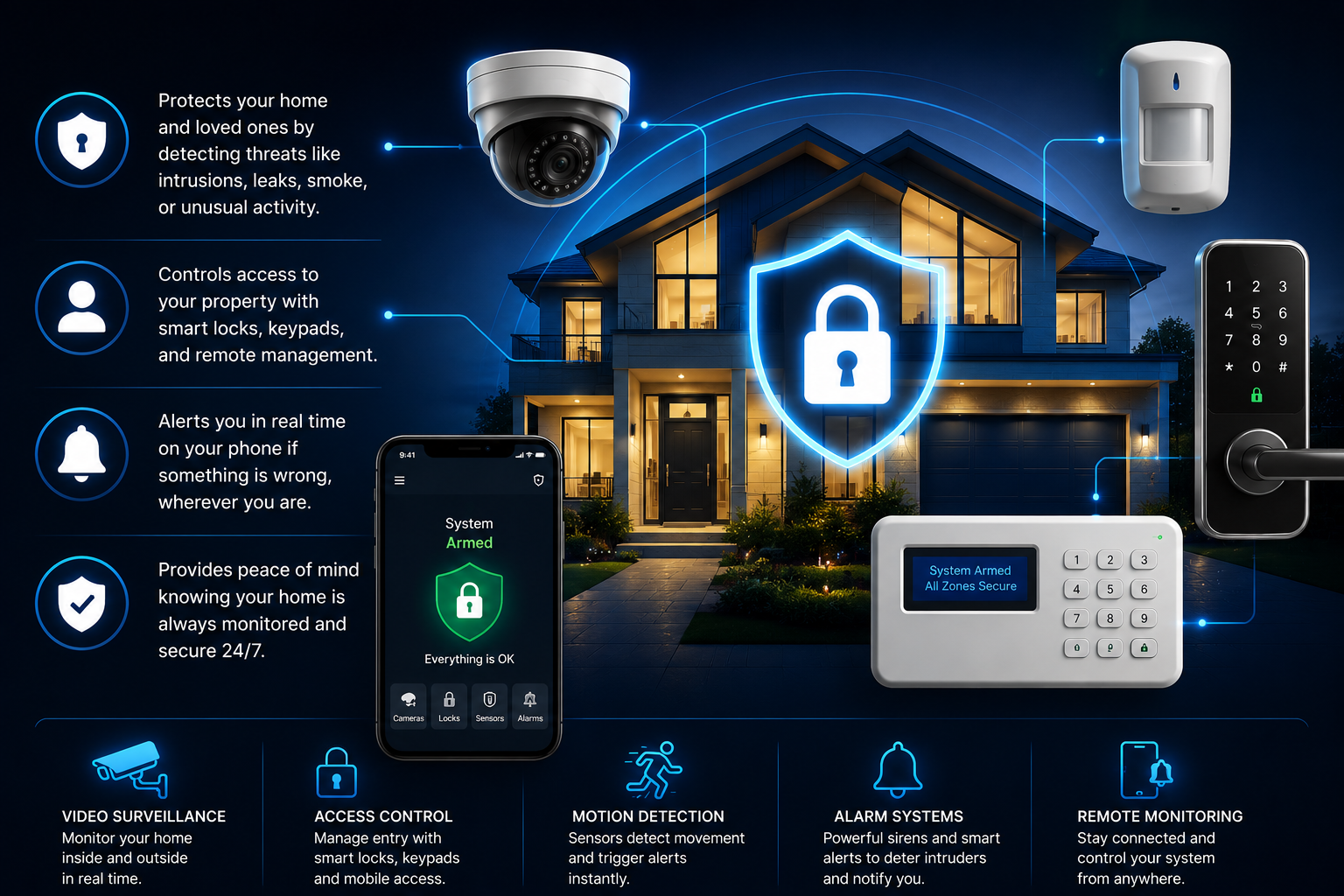
Another significant aspect of what polices a home is security. The traditional systems were the easy locks and deadbolts. In today’s home, there are both physical and digital security at work.
Alarm panels are the hub of security systems. These are linked to door sensors, movement detectors and cameras. They can be activated and alarm systems are triggered, or they can alert homeowners directly. Numerous systems are also linked to monitoring companies for extra security.
Smart locks are also in vogue. They allow homeowners to control access remotely via a mobile phone app. This is particularly helpful to give temporary access to guests or service providers.
Cameras and Monitoring
A home with security cameras is a home with an extra layer of security. They log the activity and alert when motion is detected. When paired with smart doorbells, cameras provide homeowners with live knowledge of who’s at their door. The technology has changed the way people relate to the control of home safety.
Automation Houses: The New Home Control.
The next generation of home control is automation houses. Instead of controlling each equipment separately, robot houses connect them all to a single platform. Then lights, temperature, security and more can be controlled via a single app or with voice commands.
Sensors and smart devices are communicating at all times in automation houses. For example, the motion sensor could activate automatically the lights. In the meantime, a smart thermostat could help reduce the temperature when everyone is gone. This is a connected way of doing things, which makes life easier and sometimes saves energy as well.
Common automation house platforms are Google Home, Amazon Alexa and Apple HomeKit. Such systems enable homeowners to operate devices using just their voice. Consequently, there is no doubt that the market is now dominated by automation houses for new builds as well as renovations.
Benefits of Automation Houses
There are some distinct benefits to using automation houses. The first is that they operate the machine more efficiently by adjusting the settings automatically. Second, they provide real-time alerts and remote monitoring for added security. Third, they provide for convenience, as homeowners can manage it all from a single device.
Automation houses need stable internet connectivity, too, however. Many of the smart functions don’t work as they should without Wi-Fi. It is advisable to keep in mind before splashing too much money on automation houses.
Smart Home Hubs: Central Brain
Smart home hubs are like the brain of automation houses. These are the hubs that serve to communicate between devices. They convert various wireless communications protocols to the same language as Zigbee, Z-Wave or Wi-Fi.
Without a hub, individual smart devices are not very integrated. One works with them easily! It’s one of the many reasons that automation houses have become so popular in recent years. There’s no longer a need for homeowners to have dozens of different applications to manage their homes.
It is important to select the appropriate hub based on the devices that you have. Depending on the exact hub, some brands tend to be more successful than others. Knowing the information about options prior to purchase is a great way to save time and frustration later.
Energy Management: Controlling Consumption
Energy management goes hand in hand with the financial control of a house. Smart meters monitor electricity consumption on the actual time scale. This information can assist homeowners in recognizing wasteful habits and make changes.
Solar panels are also increasingly becoming part of the home energy control. Many systems are now incorporating battery storage so that excess energy can be stored for later use. These systems, combined with smart inverters, maximize energy use and save energy.
An energy management system is frequently built in to an automation house’s platform. That allows homeowners to see how energy is being used, schedule when to use it to conserve energy, and even sell excess power back to the grid in some areas.
Structural & Mechanical Controls
In addition to electronics, there are structural elements that also control a house. Insulation maintains natural temperature control and decreases the need to keep HVAC systems running. Airflow and light through windows and doors. The roof itself has an impact on a house’s heat management.
Garage Door Opener and automatic gates are mechanical systems that provide additional control. These are all little things, but they can add up to a lot of convenience and security.
These mechanical systems are kept in good working order with regular maintenance. For example, an operating garage door can pose a safety threat as well as a security threat.
How to Take More Control Over Your Home
Once you know what makes a house, you may want to know how to be the one in control. First, know the locations of important systems: electrical panel, water shut-off, and thermostat. Understanding these fundamentals will have you ready for emergencies.
Then, think about moving towards smart technology over time. Don’t sell your home as one of the many automation houses “overnight”. Rather, begin with one system, such as security or lighting, and then add other systems.
Lastly, have routine maintenance. Periodic inspections are beneficial to HVAC systems, electrical panels and plumbing. This is a proactive measure that ensures that no systems are broken or repaired, saving you money.
Simple Steps to Better Home Control
- Clearly label your electrical panel.
- Install a programmable or smart thermostat.
- Install simple security cameras, or sensors.
- If you have several devices, think smart hub!
- Have HVAC/ plumbing inspections every year.
These little things count! With time, you get a better understanding of what makes a home function and how to make it run efficiently.
Conclusions: What Controls a House?
So, what controls a house? It is not just one system, but a combination of electrical, HVAC, plumbing, security, and structural systems working together. Each one contributes to the home’s comfort, safety, and efficiency.
The development of technology has paved a new way in automation houses which is changing the way we interact with our homes. Homeowners no longer need to control each system individually, instead they can control everything from a single location in the form of a smart hub and app. This change brings home efficiency and management to a new level.
If you remain in the traditional systems or opt for full automation houses, having knowledge of what controls a house is the power for you to make a better decision. Whether you need to make your home safer or save money, the information you can find here can make your home more comfortable, secure, and efficient for years of enjoyment.