
Introduction
The First Few Minutes, What Happens to Your Body When You Work Out?
As soon as you get moving, your body begins to gear up for action. The faster your heart rate increases. Your breathing quickens. Your muscles begin to extract oxygen from the blood quicker. These are all early reactions to the sudden need for energy.
In the first two minutes, your body depletes its stored ATP (adenosine triphosphate), the main fuel molecule for muscle contraction. Then it turns to glycogen, glucose that’s stored in your muscles and liver. The more intense the activity, the more lactic acid will be produced in your muscles. Contrary to popular belief, it is not lactic acid that causes soreness. It is in fact a useful fuel source. The burning sensation you experience is actually due to hydrogen ions, and not lactic acid.
Examine how your muscles change when you exercise
This process is called muscle protein synthesis. The body must have sufficient protein and rest in order to be effective. With no recovery time the muscles can rebuild ineffectively. This is why rest days are essential as well as training days.
Running, cycling and other aerobic activity are unique. It makes your muscle cells work more efficiently. They start to produce more tiny structures in each cell called mitochondria, which produce energy. The more mitochondria, the more endurance.
What goes on in the heart and lungs during exercise
One of the best ways to care for your heart is to exercise. During exercise, your heart beats faster and harder to supply your muscles with oxygen-carrying blood. This strengthening and improving the efficiency of your heart over time. With training, the heart will store more blood and pump it out at a lower heart rate, and that is why athletes may have a lower resting heart rate than someone who is not active.
Your lungs get better as well. They do not get bigger; your breathing muscles become stronger. Your body learns to make use of the oxygen more efficiently in every breath. The transfer of oxygen and carbon dioxide at the surface of the lungs is more efficient. These changes decrease your cardiovascular demands not just during exercise, but throughout the day as well.
How does working out affect the brain
Few people realize that exercise has a profound effect on the brain that is not limited to the physical! The impact is equally as powerful — and, perhaps, as significant.
During exercise, your brain releases an abundance of hormones and neurotransmitters. Probably the best known of these are the endorphins. They produce that infamous “runner’s high” euphoria and dulled pain sensation that can persist for many hours after a run. Other chemicals are also released, such as dopamine, serotonin and norepinephrine. These chemicals are a key factor in controlling mood, motivation, and concentration.
It is for this reason that exercise is so powerful to mental health. Exercise has been proven over and over again to be as effective as antidepressant drugs for the treatment of mild to moderate depression. It is also very effective for anxiety. Does exercise decrease anxiety? The answer is yes – and there is scientific proof to support it. Exercise lowers the amount of the body’s stress hormones, adrenaline and cortisol. Meanwhile, it activates the release of these feel good neurotransmitters.
Why is it that exercising helps you relieve stress? During exercise, the body sends into a controlled state of stress. Your heart rate increases, your muscles are forced to work and your body experiences the fight-or-flight response, but in a safe place. With time, this helps to make your nervous system resilient to stress. You’re able to withstand stress more. Things that used to cause anxiety seem more manageable following regular training.
Exercise also stimulates the growth of new brain cells in the hippocampus, the region that relates to memory and learning. That is why regular exercise is associated with
Exercise also stimulates the growth of new brain cells in the hippocampus, the region that relates to memory and learning. That is why regular exercise is associated with improved cognitive functioning, concentration and a lowered risk of dementia later on in life.
The long-term benefits of exercise on mental health
The benefits of exercise for mental health are not only immediate, they build up over time. Those who exercise regularly say they feel less stressed, sleep better and have higher self-esteem. Exercise and mental well-being are interdependent. A better physical feeling leads to a better mental feeling. But when you feel better, you’re more inclined to continue exercising.
Can exercise actually specifically reduce anxiety? Absolutely. Just one bout of moderate physical activity can make anxiety fade for several hours post-workout. The anti-anxiety activity becomes a regular part of your usual state of being over the weeks and months of regular training. Physical arousal (faster heart rate, higher breathing rate) is not always a threat, as learned through exercise. This decreases hypervigilance which contributes to anxiety disorders.
What are additional benefits of exercise on mental health? Incorporating a social element. Fitness groups, sports teams, running clubs and gym communities provide meaningful relationships. Many people do not realize that physical activity provides many social benefits. Exercise is a natural environment for developing belonging, accountability and friendship in humankind. Social benefits of exercise are a decrease in loneliness, increased sense of purpose and emotional resilience. How can an activity be beneficial to society in real life? It just means that you’re less likely to feel isolated and more likely to feel supported in your every day life.
What happens if you do exercise every day?
Many question what occurs in the body, when a person exercises daily? This is a case-by-case scenario, depending on the type and level of exercise that you select. Most people can engage in light to moderate exercise, such as walking, yoga or low-intensity cycling, without harm. It can help to keep your metabolism going, maintain joint health and improve mental clarity.
But, with intensive training every day without rest can cause OTS (Over Training Syndrome). Symptoms are fatigue, poor performance, irritability, and higher risk for injury. Variety and smart programming is the key. Changing from high intensity days to low intensity recovery days enables your body to get better and better each day without fatigue.
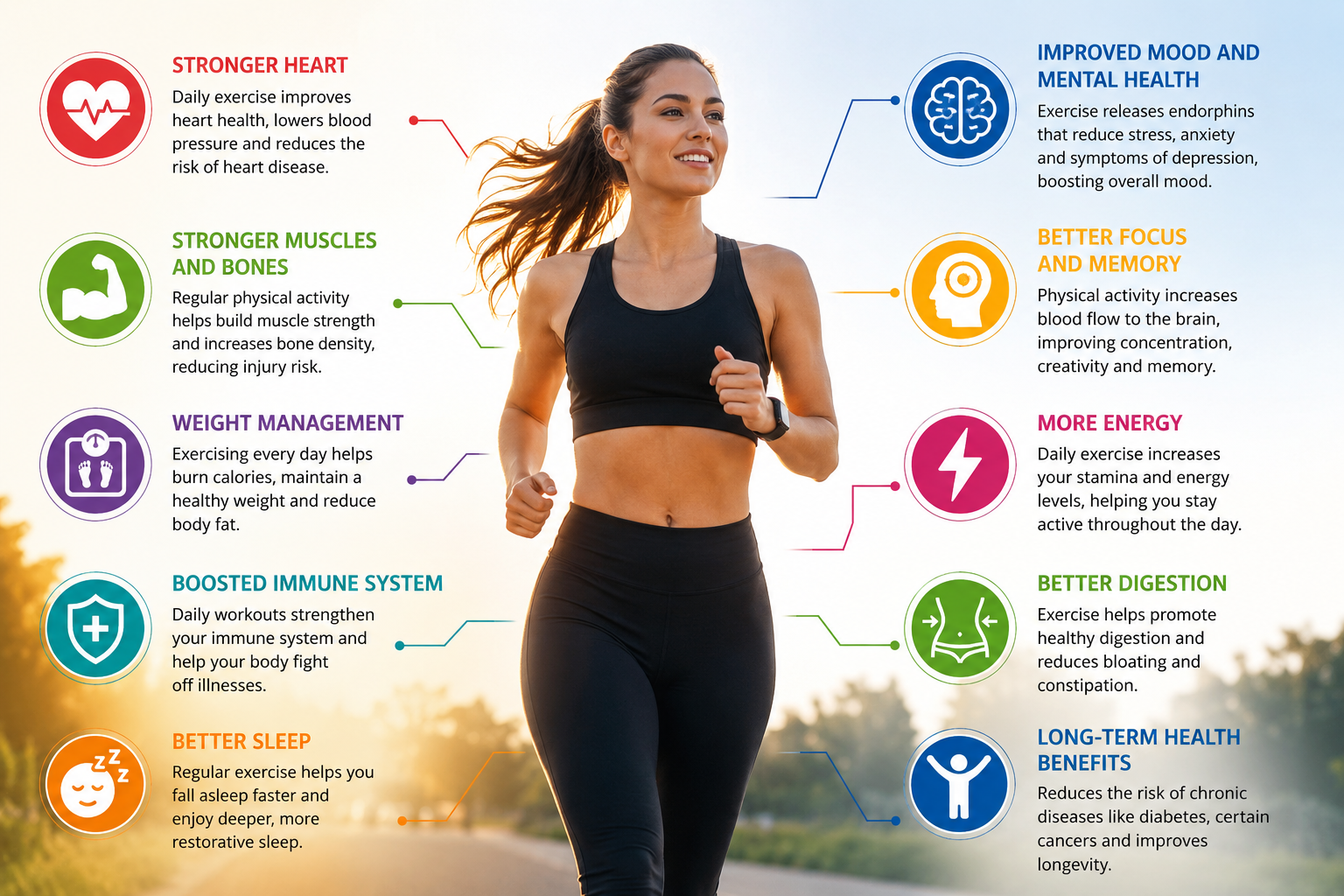
Movement brings almost all of these advantages that we have mentioned, up to a pace of nearly every day when it is applied properly. Your vascular system and heart are more effective. To maintain “in shape” muscles. More feel-good chemicals are being produced by your brain. You are able to sleep better. You have a good sense of energy stability. Many health professionals would agree that this is one of the best things about being physically active for life: it significantly extends your number of healthy, high-quality years.
Hormones play a role in workout and recovery
Exercise has a major impact on hormones; they are the chemical messengers of the body. When your body is in action it produces adrenaline and cortisol to free up energy. Growth hormone spikes – particularly during heavy training sessions and recovery phase immediately after training. Growth hormone is very important for the repair of muscles, the metabolism of fats and the regeneration of tissues.
Resistance training causes an increase in Testosterone levels for both men and women, before and after the workout. This helps in building muscle, strengthens bones and overall vigor. Exercise has a beneficial effect on insulin sensitivity. Your cells open up to insulin, making it easier for them to better manage blood sugar. That’s why physical activity is a key component to living with and preventing type 2 diabetes.
The hormones that control hunger and fullness also change regularly with training: Leptin is a hormone that signals a sense of fullness and Ghrelin is a hormone that signals hunger. Regular exercise is more likely to regulate appetite, and over time, this makes it easier to maintain a healthy weight without obsessing over the number of calories consumed. Exercise, when paired with healthy eating, can have a positive effect on a person’s hormones that dieting alone can’t.
What is the reason people get involved in exercise? The Deeper Motivation
Knowing the rationale behind human exercise helps to clarify why some people stick with it and others don’t. People who engage in exercise for a deeper motive, one that is not focused on looks are the ones that are doing the best. Some work out is a way to de-stress. Others do it for a sense of power and self-assurance. Others exercise to have the energy to be present in their lives, and for their families and work.
Why is it beneficial to exercise? The list is actually long and lengthy. Increases heart strength. Promotes bone and muscle growth. Your mind is stimulated by it. This renders you feel better. It lowers the chance of developing long-term illnesses. Promotes restful sleep. Gives you confidence. It’s a way to connect with a community.
How is sport beneficial to you other than fitness? Sport helps people learn to be disciplined, resilient and a part of a team. It makes you feel good and gives you a sense of accomplishment that goes throughout your life. At its core, why people exercise is because they are made for physical activity and it is essential for human health and happiness. We all have been made to move. Without adequate movement, our joints. Our mood. It’s it all. From our joints to our mood, it’s it all if we don’t get our movement on.
Healthy eating and exercise is a powerful combination.
Physical activity is effective on its own. Combine it with proper nutrition and it enhances all the benefits. Healthy eating plus exercise go together and have a greater benefit than either alone. Food is the raw material that your body needs to repair the muscle damage, fuel your activity and regulate your hormones. Even a best workout plan will not work without proper nutrition.
Protein helps to repair muscle tissue. Carbohydrates fuel performance. Good fats are essential in hormone production and joint care. Iron, Magnesium, Vitamin D are micronutrients that have critical functions in energy production and immune function. Maintaining proper hydration is also very important. Dehydration, even to the point of slight dryness, could affect performance and/or perceived effort.
There are combined benefits of eating healthy and being physically active, such as quicker recovery, improved body composition, increased energy levels and enhanced immune function. Consider physical activity to be the trigger and food to be the ingredients. They both are essential to achieve change.
What your body does when you work out regularly: Long-term changes.
The best change is seen over the course of months and years of regular training. Here’s how your body will look if you work out regularly for a long time.
Your heart rate decreases while you’re at rest. Blood pressure returns to normal. You have more lung capacity. Your muscles get larger and have a higher metabolic rate. The bones in your body get stronger. You become more flexible and balanced, less likely to fall and injure yourself. Your immune system is strengthened. Better circulation can help you get better skin. You fall deeper and deeper into sleep and you sleep more deeply.
In conclusion, the benefits of working out are truly remarkable.
So, you now know what the exercising effects were on your body — and it’s pretty great. Physical activity affects all of your systems. Helps build stronger heart and lungs. It helps repair muscle tissue. Rewires into your hormones. Changes brain chemistry. It makes you feel good, concentrates your mind and strengthens your relationships.
It’s not a question of if you should exercise, it’s a question of how. There is no doubt about it. The question is, what movement will you be going down on today? No need to run a marathon or to lift heavy! Begin with the things you like. Take a walk, swim, dance, ride a bike or participate in a local sport team. Take moderate activity most days for a minimum of 30 minutes.